


6 Best AI Governance Platforms for Enterprise Compliance 2026
"AI governance" now means two different jobs. Most buyers find it the hard way.
One job is governing the models your data science and risk teams build and buy. That means proving that:
- A credit model isn't biased
- A use case maps to the EU AI Act
- An auditor can trace a decision
The other job is governing the AI agents your employees are already running today.
A chatbot answers prompts. An AI agent uses a large language model to take actions on your behalf.
The difference is material. Because an AI agent can:
- Call and use tools
- Read, exfiltrate, or delete data
- Make irreversible changes
Agents can reach into your apps (Jira, GitHub, Salesforce, and Snowflake) through a growing pile of MCP (Model Context Protocol, the open standard that lets an agent connect to a tool) and API connections, or into your server or GitHub repository.
The platforms below are good at different jobs. This maps which job each was built for.
Platforms were selected based on their standing as top players in the enterprise AI governance market, with reference to the Forrester Wave: AI Governance Solutions (Q3 2025) and Gartner AI Governance Platforms Magic Quadrant (June 2026).
We evaluated publicly documented capabilities, and weighed them against the governance layers that enterprise compliance and security teams are audited against in 2026 (such as the EU AI Act, NIST AI RMF, SOC 2, and ISO 27001.)
Model governance and agent governance solve different problems
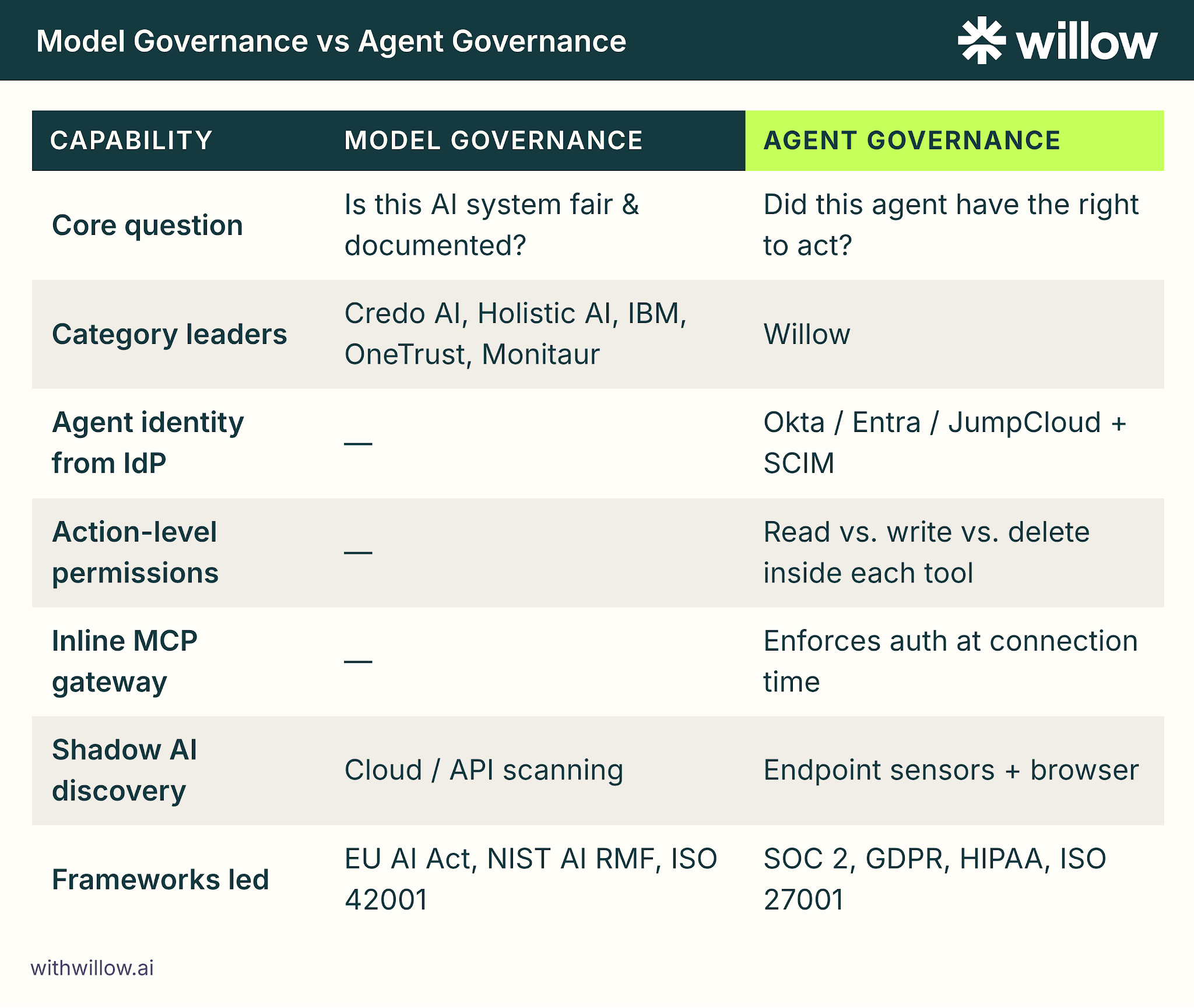
Model governance and agent governance answer fundamentally different audit questions, and the gap between them is where most compliance programs fail.
Model/policy governance asks "is this AI system fair, documented, and compliant?"
Agent governance asks "did this agent have the right to take that action, and can I prove who it was acting for?"
A platform built for one rarely covers the other well. Buying the wrong one is about more than just feature coverage, it leaves a real gap on your next audit.
That gap becomes regulatory exposure, and risk of exploitation by hackers or bad actors.
Model governance is the mature category. These platforms inventory every model and use case, run bias and risk assessments, map controls to regulatory frameworks, and generate audit-ready evidence.
Such tools include Credo AI, Holistic AI, IBM watsonx.governance, OneTrust, and Monitaur.
Agent governance is the newer layer. It's where operational risk has shifted and companies are most blind.
The questions AI agent governance helps you answer are different:
- Identity: Whose identity is this agent acting under, and does that inherit from your identity provider (Okta, Entra ID, JumpCloud) that already holds your employee accounts and group memberships?
- Permissions: Not just “can the agent reach Jira” but “what can it do *inside* Jira (read a ticket vs. delete a project)?”
- Runtime enforcement: Is something sitting inline between the agent and the tool at connection time, or are you reading traces after the fact?
- Shadow AI: Shadow AI is any AI tool, agent, or connection an employee runs without IT approval or security review. Can you see the rogue MCP servers and personal API keys on employee laptops right now?
A model governance platform tells you a model is registered and assessed. An agent governance platform stops an agent from deleting a Salesforce record it was never permissioned to touch.
Both matter and you likely need both, but the wrong pick for your primary gap shows up on the next audit.
Layer 1 (model/policy governance) proves a model is fair and documented. It includes an AI registry, bias and risk assessment, and regulatory-framework mapping.
Layer 2 (Agent governance) proves an agent acted within its scoped rights in approved environments. It includes agent identity, app-aware permissions, an MCP gateway, and shadow AI discovery.
Most platforms in this guide live cleanly in Layer 1. One, Willow, lives in Layer 2.
Why the shift matters for compliance buyers
Every major platform shift in enterprise IT created an identity gap.
On-prem applications got their identity and access layer in Active Directory.
The move to SaaS created a new gap. Hundreds of cloud apps, no central control. Okta (and Entra ID, JumpCloud) filled it with single sign-on, SCIM provisioning (the standard that automatically creates and removes a user's access as they join, move, or leave), and a single audit trail tied to a real employee.
But AI agents have nothing, and enterprises are exposed for exactly that reason.
Agents are the third wave, and right now most enterprises govern them with nothing.
AI agents also happen to be moving faster than anything before. The tooling is multiplying week over week, with a fast-moving open-source community behind it.
Closing this gap requires a speed of action and implementation that IT orgs have previously not had to keep up with, outside of perhaps cybersecurity.
Active Directory and Okta deprovision a leaving employee automatically. Agents running on personal API keys have no equivalent trigger because nothing ties their actions back to a named person.
Willow is the identity and access layer for AI agents, the Agentic Access Platform in this guide. Each agent inherits a real employee's identity from your existing IdP, gets permissions scoped to what it can do inside each tool, and is deprovisioned automatically when that employee leaves. What Okta became for SaaS, Willow is built to be for agents.
The 6 best AI governance platforms for enterprise compliance in 2026
The best platform depends entirely on whether your primary risk lives in models or in agents.
This list profiles each tool for what it governs, then names the buyer it fits.
Five are model/policy governance leaders. One, Willow, is the Agentic Access Platform.
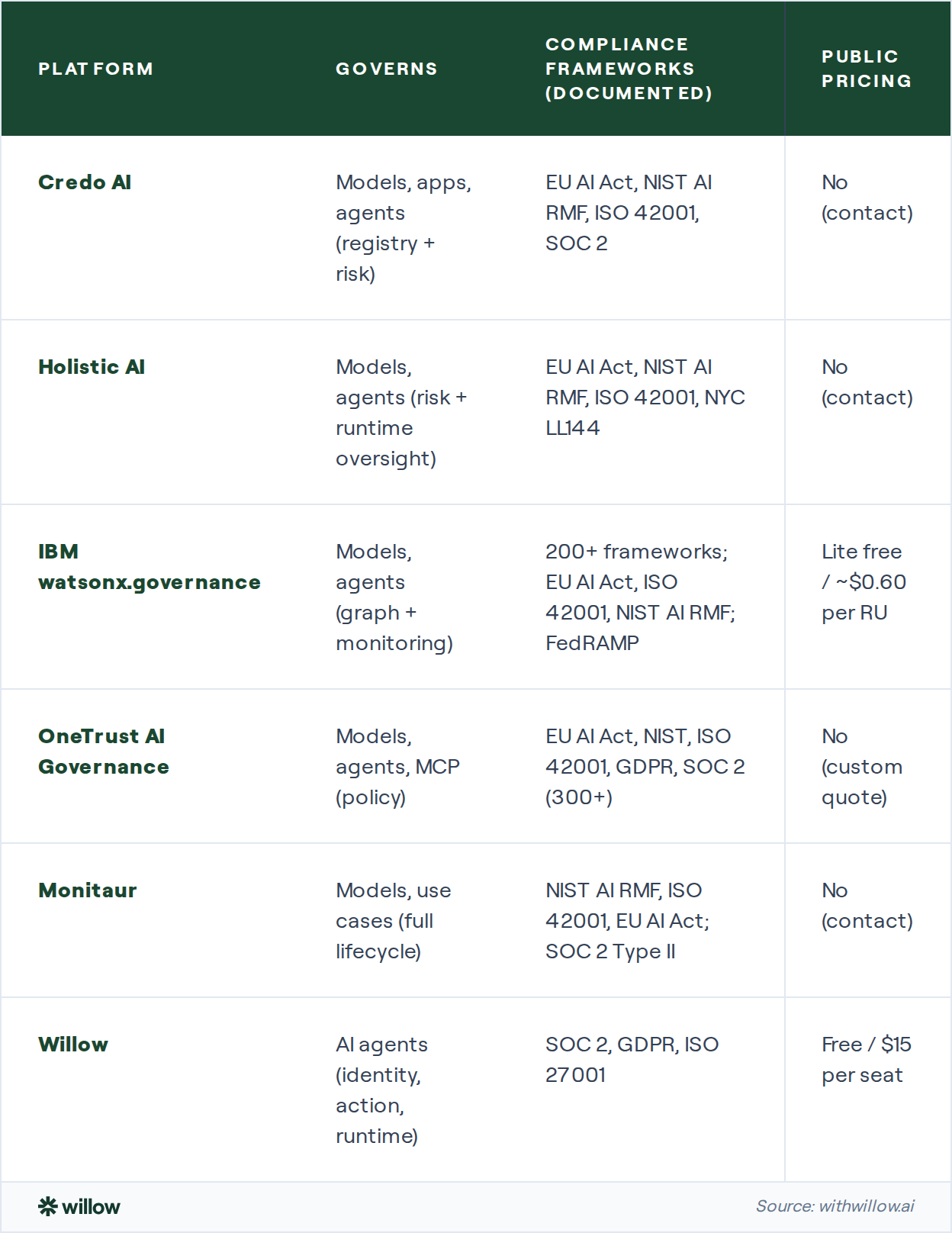
The table below maps every platform to what it governs and which compliance frameworks it documents support for.
Credo AI: the analyst-recognized model and agent governance leader
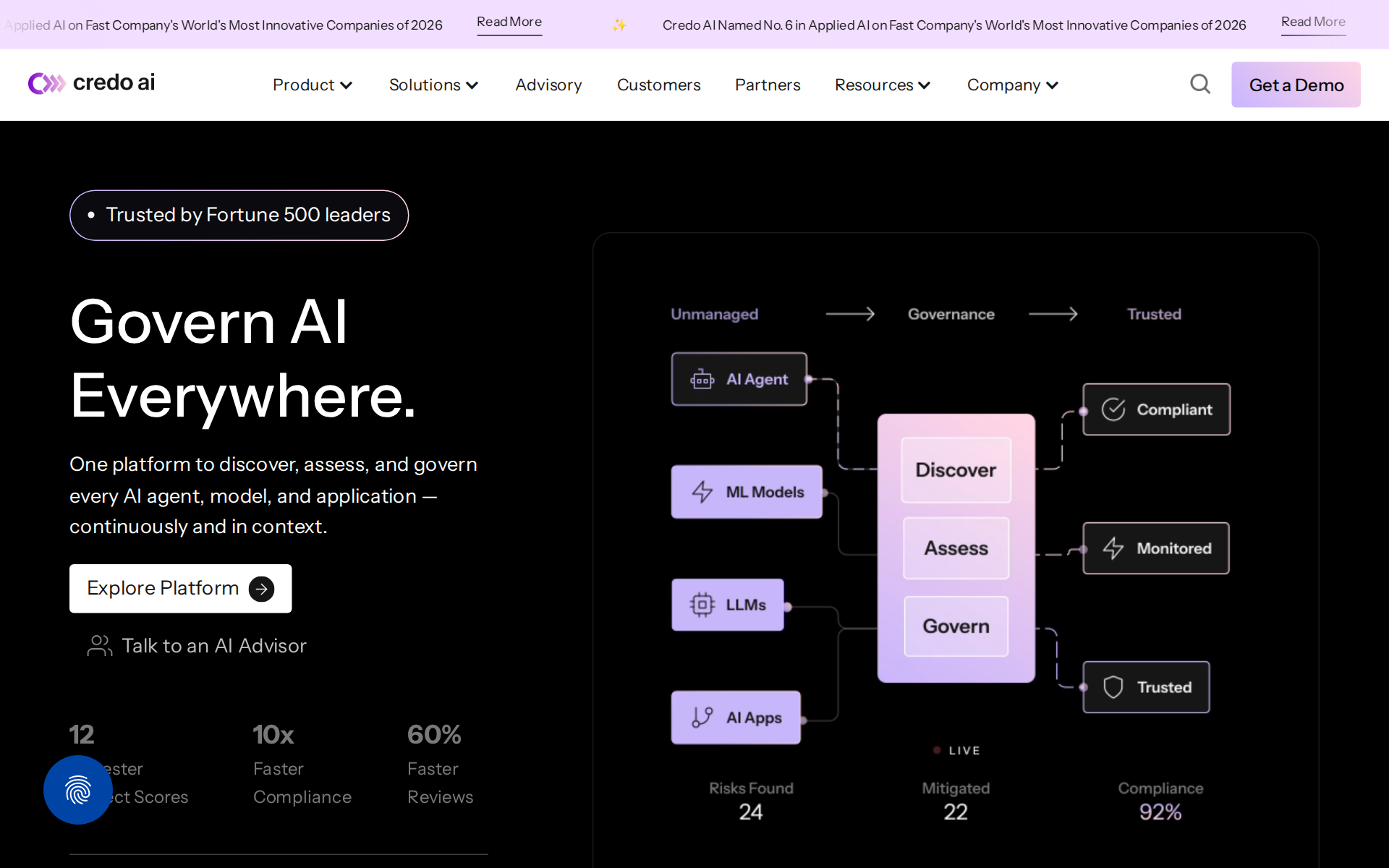
Credo AI is the strongest pure-play AI governance platform for enterprises that need to discover, assess, and document every AI system across the org.
It centralizes an AI Registry covering models, applications, agents, and shadow AI.
Rather than give you a static point-in-time snapshot, continuous risk assessment runs across a broad set of risk dimensions.
The platform ships with pre-built policy packs for the EU AI Act, NIST AI RMF, ISO 42001, and SOC 2 with audit-ready evidence generation.
Credo AI was named a Leader in the Forrester Wave: AI Governance Solutions (Q3 2025), with the highest possible score (5/5) in 12 criteria, and landed at #6 in Applied AI on Fast Company's World's Most Innovative Companies of 2026.
For Agent heavy workloads, it comes with:
- An Agent Registry with agent cards and dependency graphs.
- A GAIA governance assistant that automates intake and control mapping.
- A public MCP server in preview that exposes the platform to customer-built agents.
However, Credo AI's runtime governance evaluates agent traces and applies policy after behavior is observed. It does not currently evaluate at connection time.
It provides no inline MCP gateway, IdP-inherited agent identity, or per-action permissions inside tools. Enforcement integration with CI/CD pipelines and API gateways is on the public roadmap but not yet shipped as of this writing.
Credo AI is the right pick if you need to govern, document, and prove compliance across a whole AI estate.
Holistic AI: strongest model risk testing with real-time agent oversight
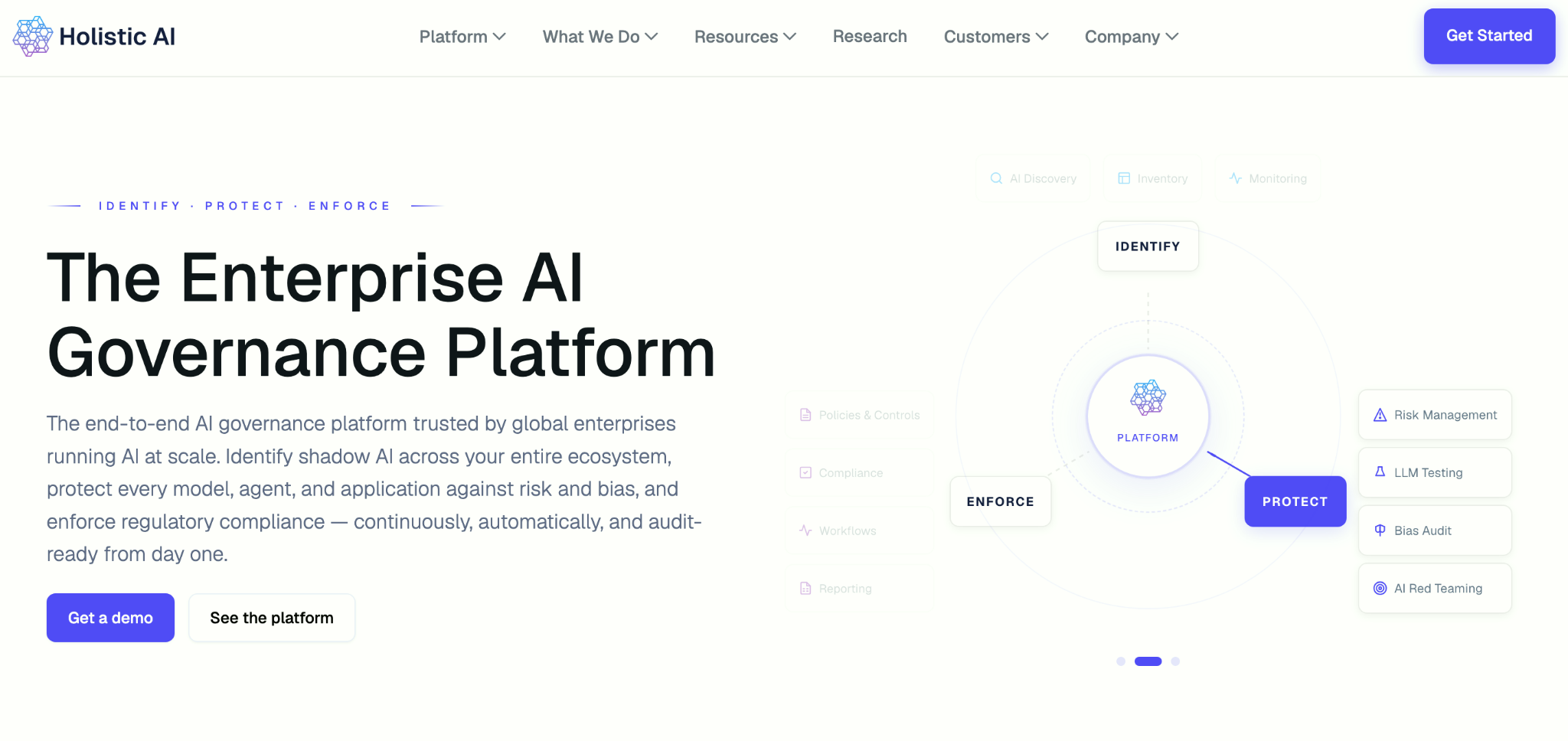
Holistic AI is the best fit for enterprises whose top concern is bias, safety, and adversarial risk in their AI systems.
It runs 40+ specialized tests spanning:
- Bias
- Fairness
- Toxicity
- Hallucination
- Prompt injection
- Jailbreak resistance
Risk scores get mapped to the EU AI Act, NIST AI RMF, ISO 42001, and NYC Local Law 144, covering each model’s regulatory obligations.
AI discovery scans 20+ cloud and SaaS integrations to surface shadow AI and classify it by risk and owner.
On agents, Holistic AI is one of the closest model-governance vendors to runtime control. Its Guardian Agents architecture pairs Sentinel Agents (observe and evaluate every agent action against policy in real time) with Operative Agents (intervene and remediate when thresholds are crossed).
A 2026 update added tool-calling, access control, and cost control for agentic systems in production.
Two gaps matter for enterprise buyers.
Guardian Agents observe and intervene, but there's no inline MCP gateway handling auth at connection time, and the platform cannot inherit agent identity from an employee IdP.
Holistic AI is a strong choice when model risk and bias testing is the core job, and runtime agent oversight is a strong plus.
IBM watsonx.governance: broadest regulatory coverage for large regulated enterprises
IBM watsonx.governance is the platform to beat when multi-jurisdictional regulatory coverage is the deciding factor for your organization.
It supports 200+ regulatory frameworks with automated applicability, evidence collection, and audit-ready reporting. That is the deepest framework coverage among the dedicated AI governance platforms in this comparison.
It's FedRAMP-authorized on AWS GovCloud, a Forrester Wave Leader for AI Governance, and a Gartner AI Governance Platforms Leader (June 2026).
Governance Graph maps the entire AI ecosystem (assets, policies, risks, and regulatory requirements).
Continuous drift and bias monitoring are also included.
But there are three caveats.
First, the agent monitoring is recent (GA December 2025) and less mature than the model governance core.
Second, on-prem deployments require Cloud Pak for Data VPC licensing, which adds cost and complexity.
Third, there's no agent identity layer, no inline MCP gateway, and no endpoint-level shadow AI discovery.
IBM watsonx.governance fits large, regulated, IBM-ecosystem enterprises that need maximum framework breadth.
OneTrust AI Governance: unified GRC with documented MCP policy enforcement
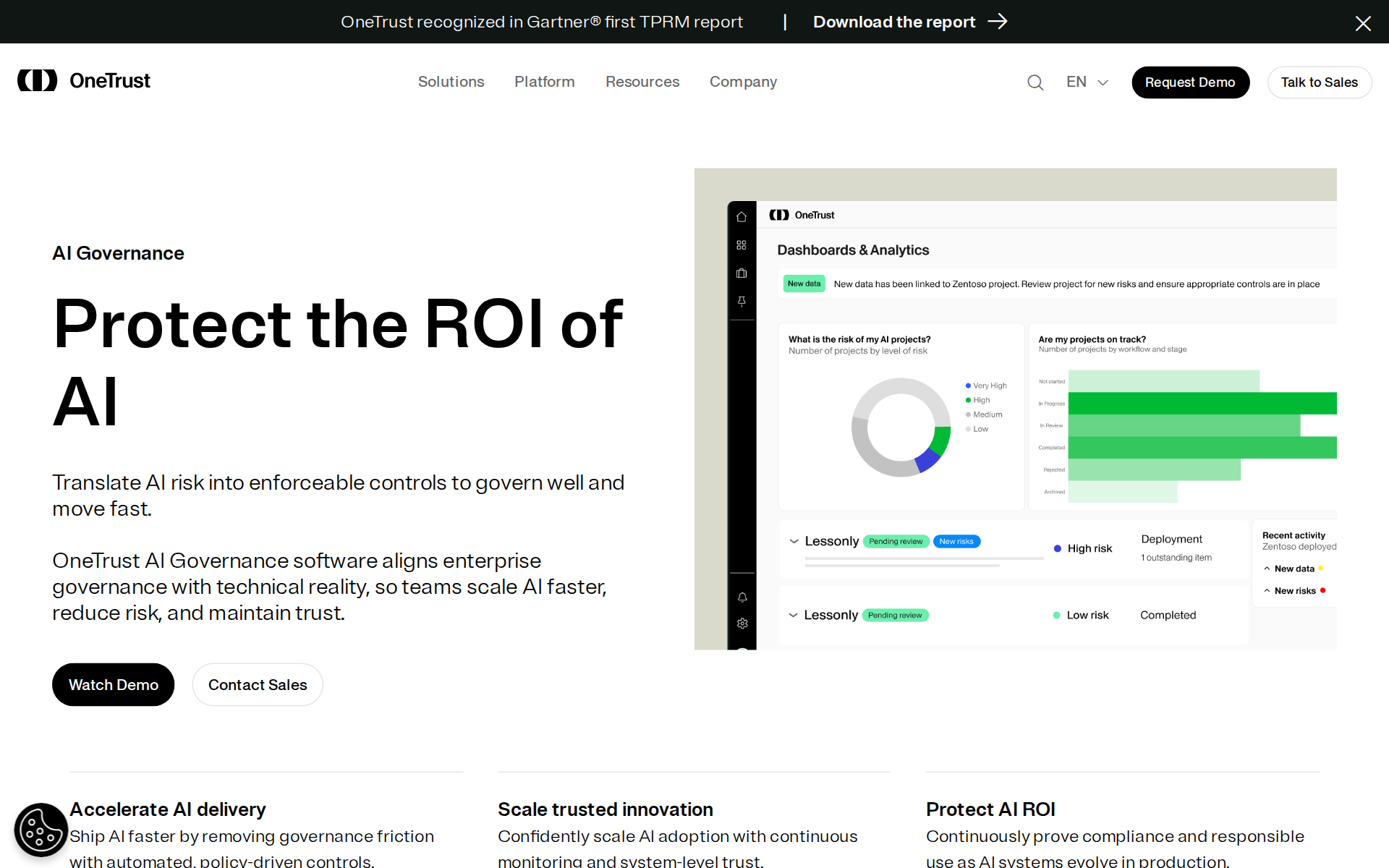
OneTrust is the best fit for enterprises that want AI governance living inside one platform alongside privacy, data governance, and third-party risk.
It extends OneTrust's mature governance, risk, and compliance ecosystem.
MCP policy enforcement with audit logs come built in, alongside agent registration with defined purpose and enforced allowed actions.
It also announced AI agents (Privacy Agent, Third-Party Risk Agent) in September 2025 to automate governance work.
OneTrust's strength is workflow and documentation, not inline runtime defense.
Its runtime controls are policy-triggered via AI Guardrail Enforcement rather than a protocol-level inline gateway.
Its strength is compliance workflows and documentation.
OneTrust is not built with the purpose of intercepting every agent-to-tool connection before it occurs.
The platform also carries a steep learning curve for leaner teams that are unlikely to staff a dedicated GRC function.
It also lacks IdP-integrated agent identity and an inline MCP gateway.
OneTrust is the right choice for enterprises already standardized on OneTrust GRC who want AI in the same data model.
Monitaur: full-lifecycle model governance for regulated industries
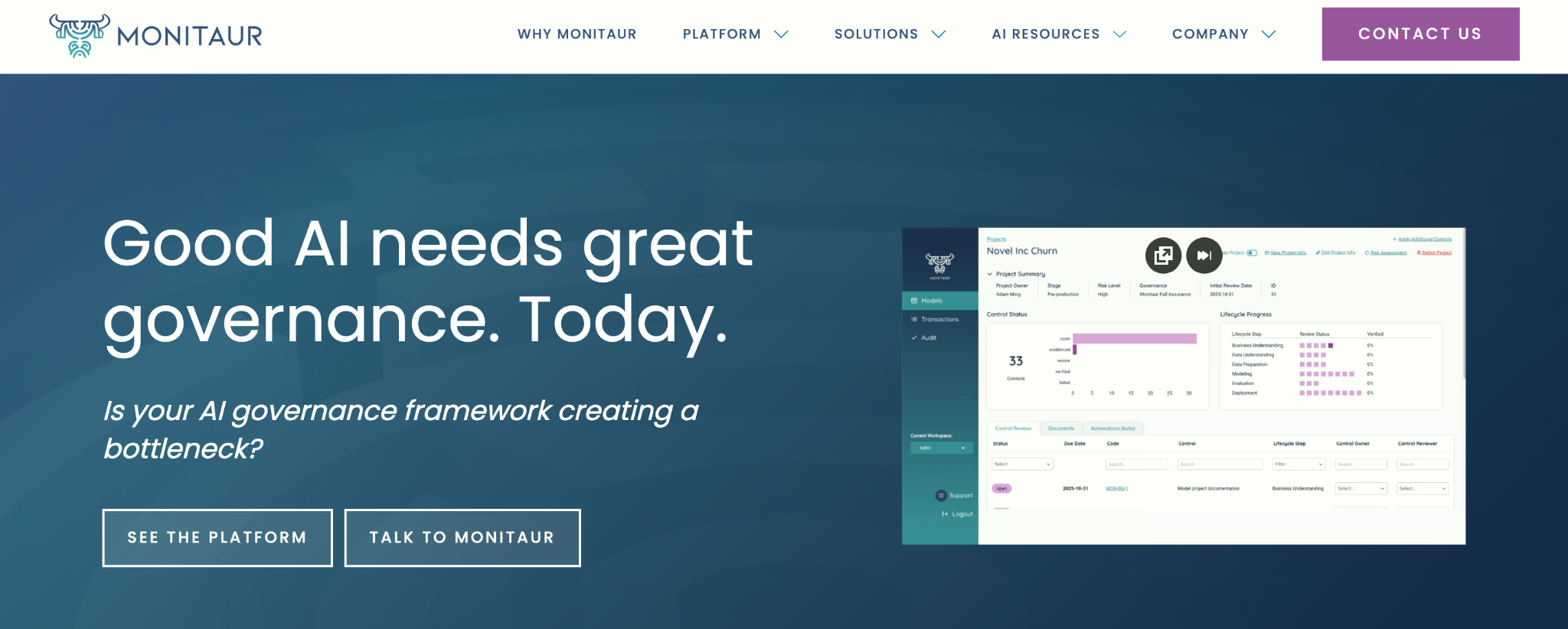
Monitaur is built for highly regulated enterprises. Primarily insurance, but also financial services and healthcare.
Its platform runs:
- Define (policy templates and risk methodology)
- Manage (model and use-case inventory with a Common Controls Library)
- Automate, where "FlightSim" pre-deployment simulation grades models before release
- Record which runs continuous production validation for drift and bias
The trade-off, though, is breadth.
Monitaur lacks a dedicated agent registry, dependency graph, or runtime agent governance.
However, it is a strong choice for insurance and financial-services teams that need rigorous, auditable model risk management.
Willow: the agent governance and identity specialist
Willow is the platform to choose when the action an agent takes is the thing keeping you up at night.
Willow governs AI agents at the identity, action, and runtime layers. Three things the model-governance platforms above don't do natively.
Every agent inherits a real employee's identity through the existing identity providers (Okta, Entra ID, JumpCloud).
That includes SCIM provisioning, SSO, and auto-deprovisioning on offboarding. That makes offboarding clean: agents lose access the moment the employee does.
Willow’s greatest strength, though, is in app-aware permissions. With it you can define not only which tools an agent can reach, but also what it can do inside each one.
Define whether an agent can read vs. write vs. delete, on which data, and under what conditions.
Three more top features make Willow a strong candidate for your AI agent governance stack.
(1) An Inline MCP Gateway sits between every agent and tool, enforcing auth at the connection layer and permissions at the action layer, not reading traces after the fact.
(2) Shadow AI discovery at the endpoint uses sensors and Willow for Chrome (a browser extension) to surface rogue MCP servers, personal API keys, and unapproved agents on employee machines.
(3) Audits tied to a real employee mean every agent action is logged, timestamped, and immutable in the Logbook. It comes with pre-built SOC 2, GDPR, HIPAA, and ISO 27001 exports.
Willow sits at the identity and access layer for AI agents.
That means teams can run AI agents at production scale while security has the policy controls, the audit log, and access revocation capability.
Wix's Head of AI Core, Asaf Yonay attributes their success to Willow: "We are six to ten months ahead of most companies in AI adoption. More code to production, fewer incidents."
Across the Wix deployment, Willow governs approximately 5,000 weekly active users using ~600 governed tools. Together, they generate 300,000+ governed tool calls per week (Willow X Wix).
Willow is the right pick when employees are already running agents and you need identity, app-aware permissions, and an audit trail tied to named people.
It's also the most pricing-transparent option of those in this list. It is free for up to 5 users, $15/seat for Startup, custom for Enterprise. All SOC 2 Type II certified.
Depending on your requirements, you can choose from a SaaS, self-hosted, or on-prem/air-gapped deployment, with full feature parity across all three.
Model governance vs agent governance: a side-by-side comparison
The clearest way to choose which platform is right for you is to line up the two governance types on the capabilities that decide an audit.
The table below contrasts the model/policy governance platforms (Credo AI, Holistic AI, IBM, OneTrust, Monitaur as a group) against the agent governance/agentic access platform (Willow) approach.

Read the framework row carefully. Model governance platforms lead with EU AI Act, NIST AI RMF, and ISO 42001. Agent governance leads with SOC 2, GDPR, and ISO 27001.
That difference reflects which audit each was built to pass.
If your compliance pressure is the EU AI Act, start with the model-governance leaders. If it's SOC 2 and access control over what agents touch, start with agent governance.
How to choose an AI governance platform for your enterprise
Choose based on where your risk lives, which frameworks you're audited against, and whether you need documentation or inline enforcement.
The platforms in this guide are good at different jobs, and the wrong fit shows up as a gap on your next audit or a regulatory breach your auditors can’t trace to a named actor.
Work through the below criteria before you shortlist.
Where does your risk live: models or agents?
If it's biased or undocumented models, weigh toward Credo AI, Holistic AI, IBM, OneTrust, or Monitaur.
If it's employees running agents that reach into production systems, weight toward agent governance and Willow.
Many enterprises need both layers.
If your primary compliance pressure is the EU AI Act, ISO 42001, or model bias risk, start with a model-governance platform from this list.
If employees are already running agents against production systems like Jira, Salesforce, or GitHub, start with agent governance. If both are true, plan for two layers: model governance answers the "what did we build" audit; agent governance answers the "what did it do" audit.
Which frameworks are you audited against?
EU AI Act, NIST AI RMF, and ISO 42001 point to model governance.
SOC 2, GDPR, HIPAA, and ISO 27001 access control point to agent governance.
For maximum breadth, IBM's 200+ frameworks are hard to beat.
Do you need documentation or enforcement?
Most model-governance platforms document and assess. They evaluate traces or generate evidence.
But if you need something to block an unpermitted action inline, you need a runtime gateway. You need agent governance.
What's your shadow AI exposure?
Cloud/API scanning (Credo AI, Holistic AI, OneTrust) finds AI in your cloud accounts.
Endpoint sensors (Willow) find personal API keys and rogue MCP servers on laptops.
For most enterprises, it's both.
If your shadow AI risk lives in cloud accounts and SaaS integrations, start with Credo AI, Holistic AI, or OneTrust. They scan cloud and SaaS integrations and classify AI tools by risk and owner.
If it lives on endpoints, including personal API keys, local MCP servers, and unapproved tools running on employee laptops, start with Willow. Its endpoint sensors surface every tool in use before it reaches a production connection.
There is no single best AI governance platform
Pick the model-governance leader that matches your frameworks and ecosystem.
Add the agent-governance layer if employees are already running agents against your systems.
Most enterprises in 2026 will end up running one of each.
For architecture decisions on identity, app-aware permissions, and runtime enforcement, the Willow blog covers the agent-governance layer in depth.
Most enterprises in 2026 will end up running one model-governance platform and one agent-governance layer.
Further Reading and Sources
- Credo AI: https://credo.ai/product
- Holistic AI: https://holisticai.com
- IBM watsonx.governance: https://ibm.com/products/watsonx-governance
- OneTrust: https://onetrust.com/solutions/ai-governance
- Monitaur: https://monitaur.ai/platform
- Willow: https://withwillow.ai/platform
- Wix case study (Willow): https://withwillow.ai/blog/wix-case-study
Frequently asked questions
Enterprise compliance and security teams evaluating AI governance platforms in 2026 consistently reach the same four questions about model governance, agent governance, framework coverage, and cost.
Background Agents in the Enterprise
Most teams can spin up an agent. Few can deploy one their security team signs off on. Here's the framework that does both.
FAQS
Model governance manages the AI systems you build and buy: inventorying models, assessing bias and risk, and mapping controls to frameworks like the EU AI Act and ISO 42001. Agent governance manages what AI agents do at runtime: which identity an agent acts under, what it's permitted to do inside each tool, and whether its actions are audited and tied to a real employee. Platforms like Credo AI, IBM watsonx.governance, and Monitaur lead on model governance. Willow specializes in agent governance. Many enterprises need both, because they answer different audit questions.
For EU AI Act compliance specifically, the model/policy governance platforms lead, because the EU AI Act governs AI systems and use cases rather than agent actions. Credo AI, Holistic AI, OneTrust, and Monitaur all ship pre-built EU AI Act policy packs or templates with control mapping and gap analysis. IBM watsonx.governance covers the EU AI Act among 200+ regulatory frameworks, the broadest AI-native coverage in this group. If your compliance pressure is primarily the EU AI Act, start with one of these rather than an agent-governance tool, whose framework strength is SOC 2, GDPR, and ISO 27001.
Coverage varies widely, and it's the fastest-moving part of the market. Most model-governance platforms now register agents in an inventory, and several added runtime agent monitoring in 2025 and 2026: Holistic AI’s Guardian Agents, IBM’s December 2025 agentic monitoring, OneTrust’s runtime guardrails. On MCP specifically, OneTrust is the only model-governance vendor in this research that explicitly documents MCP policy enforcement with audit logs, and Credo AI is previewing a public MCP server. None of the model-governance platforms provide an inline MCP gateway that enforces auth at connection time and permissions at the action layer. That’s where a purpose-built agent-governance platform like Willow operates.
Most enterprise AI governance platforms use contact-only, custom pricing, which makes upfront comparison hard. Credo AI, Holistic AI, OneTrust, and Monitaur all require a sales quote with no public starting price. The two exceptions: IBM watsonx.governance publishes a free Lite tier and per-resource-unit pricing around $0.60/RU (with higher tiers estimated in the tens of thousands per year), and Willow publishes transparent tiers: Free for up to 5 users, $15/seat for Startup, and custom for Enterprise. If procurement requires pricing transparency before a sales call, those two are the clearest starting points.
Everything you need to get your Basecamp running.



Your agents are already in the wild.
Give them a Basecamp. Go from AI chaos to AI work, in minutes.
