

Case Study
How Wix scaled Al-native work to 5,000 employees with Willow
Read More
vs

Willow vs. Obot: managed governance, or an open-source MCP gateway you run yourself

Obot is an open-source MCP gateway you host on your own infrastructure. Willow is a managed, certified governance platform your IT and security teams run without standing up Kubernetes. Compare both on openness, compliance, discovery, and deployment.


Trusted by

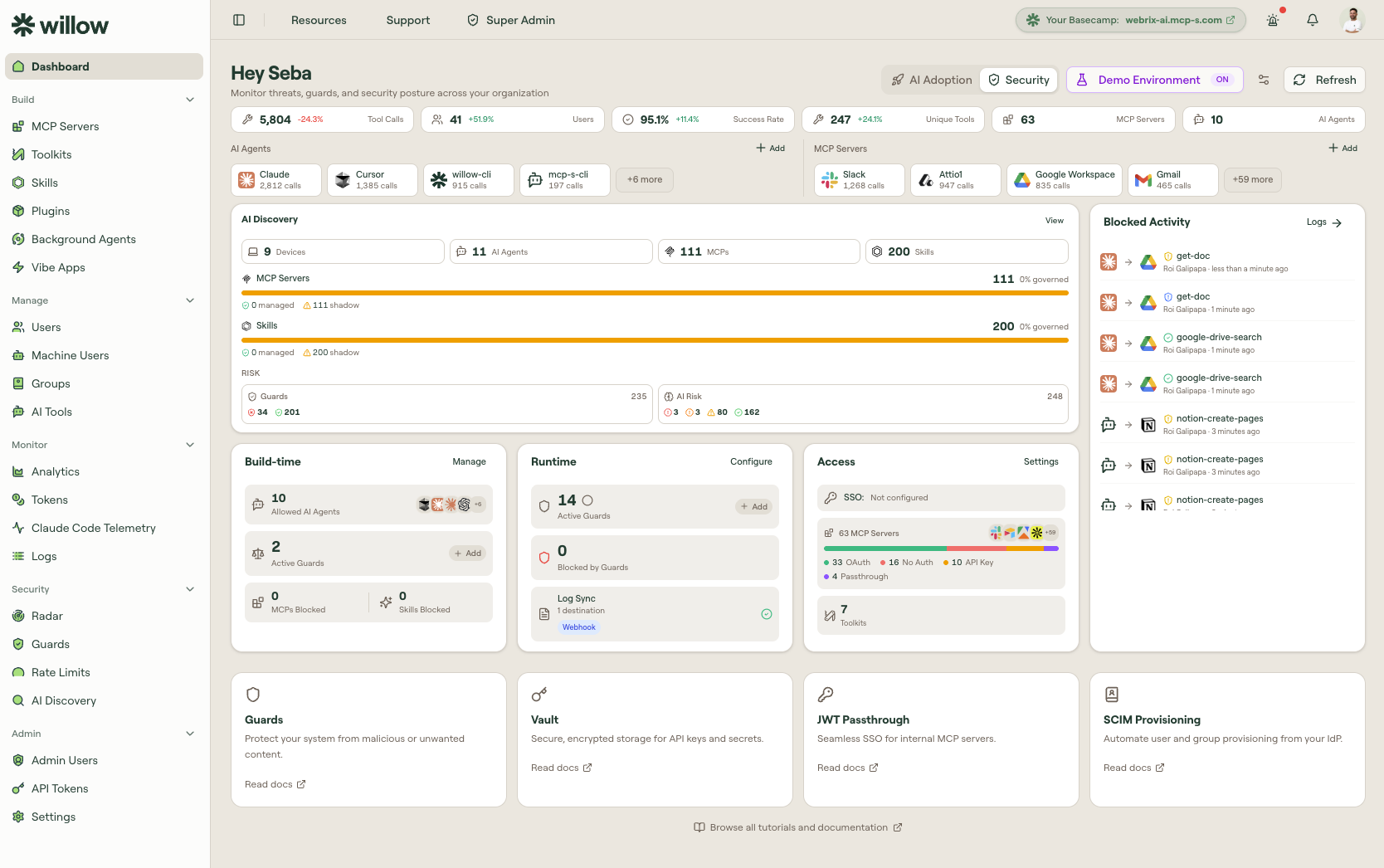
Willow Admin Console

A managed access and enablement control plane for the whole organization. It provides employee self-service, machine users, fine-grained per-agent and per-action policy, shadow-AI discovery, and IT-run identity and lifecycle, delivered as a certified managed service. It is proven at enterprises like Wix with roughly 5,000 weekly active users.
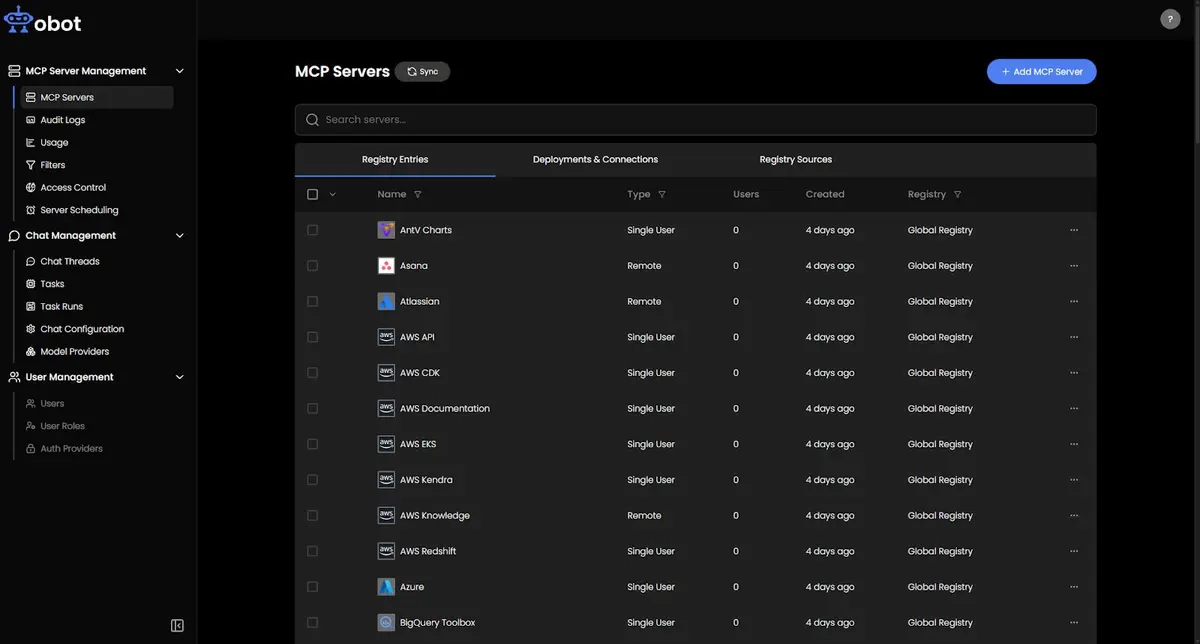
Obot dashboard interface showing MCP Server Management with a list of MCP servers, their types, users, creation dates, and registry sources.

Obot MCP Gateway

An open-source-first MCP gateway and control plane, built by the team behind Rancher and Cloud.com. The MIT core is free to self-host on your own infrastructure with data that never leaves your environment, and a commercial Enterprise Edition and managed Obot Cloud sit on top. It is a credible, well-funded challenger with a young product.

The Bottom Line

Obot is open-source with K8s deployment and GitOps config for DevOps teams. Willow provides shadow AI detection, unified build & runtime guards, infrastructure-as-code governance, and a plugin marketplace at enterprise scale.

Willow is the better fit when

You want certified, managed governance without running infrastructure yourself. It gives you SOC 2 Type II compliance out of the box, employee self-service, a curated and enterprise-vetted catalog, endpoint discovery of shadow AI across web and local usage, enterprise identity providers included rather than paywalled, and deployment anywhere including on-premises, air-gapped, hybrid, and the EU, delivered as a supported service.

Obot is the better fit when

You want a free, open-source, self-host-forever gateway where data never leaves your environment, you have the DevOps capacity to run it on your own Kubernetes or cloud, and you value an open agent framework and an auditable MIT codebase.

Pick Willow if

Your goal is to operationalize AI across real teams with governance your organization can own and adapt, backed by a vendor certification and a proven enterprise-scale rollout, rather than assembling and maintaining the gateway yourself.

Willow vs Obot, side by side

Dimension
Willow
Obot
Architecture
Managed access and enablement control plane for the organization
Open-source-first MCP gateway and control plane, self-hostable
Deployment options
SaaS, dedicated cloud, on-prem on AWS, GCP, or Azure, air-gapped, hybrid, EU residency, delivered as a managed service
Any Kubernetes cluster, Docker, any cloud, or on-prem, self-managed, with Obot Cloud as the managed option
Licensing and pricing
Commercial, managed
Open-source core under MIT, free to self-host; Enterprise Edition and Obot Cloud priced privately
Authentication
OAuth 2.0, OIDC, SAML, JWT, and SSO with Okta, Entra, JumpCloud, Google, and more, included
OAuth 2.1 built in, with Google and GitHub free; Okta, Entra, SAML, and OIDC in the paid Enterprise Edition
Identity & Access
RBAC, groups, SCIM, and fine-grained per-agent and per-action policy
Multi-role RBAC, per-tool permissions, and policy-as-code per user, group, and agent
Machine Users
Generally available service accounts, using an API key or OAuth2 client credentials
API-key auth for programmatic access; no separately documented machine-user product
Background agents
Governed autonomous agents, each with its own scoped identity, least-privilege capabilities, and full audit
Nanobot, an open-source agent framework that turns MCP servers into agents, in alpha (as of July 2026)
Connector and MCP catalog
1,000+ curated, enterprise-vetted connectors with risk scoring
Built-in curated MCP catalog with schema visibility and composite bundled servers
API-to-MCP conversion
Wrap any REST API as a governed MCP
Not a highlighted capability
Employee self-service portal
Connect Panel and marketplace, one-click connection for any employee
Publish-to-employees, instant MCP connection by URL, and a built-in chat client
IT approval workflows
Approve the catalog once, per-user MCP policy of none, needs-approval, or allow, and governance as code through GitHub
Access policies per user and group; no Git-based pull-request workflow marketed for the full configuration
Shadow AI detection
Endpoint scan agent finds MCPs, skills, and agents on web and local, with risk scoring
Governs what flows through the gateway; no endpoint discovery agent evidenced
Vibe app monitoring
Tracks employee use of vibe-coding app builders like Lovable and Base44, and flags when those apps connect to internal systems
Not offered
Governed Chrome
Browser extension for visibility into web AI usage and OAuth flows through managed Chrome
Not offered
Observability and audit logs
Full per-call logs, forwarded to Splunk, Coralogix, Loki, CrowdStrike, or a webhook, with configurable retention
Every tool call logged with user, agent, server, arguments, and outcome, with usage dashboards, encrypted at rest and in transit
AI security
Built-in runtime and buildtime guards, response PII masking, plus third-party integrations
Gateway-level MCP filtering of requests and responses, with PII redaction and payload inspection
Token optimization
Token and context optimization to cut cost per call
Usage dashboards; token-cost optimization not a highlighted capability
Compliance
SOC 2 Type II, GDPR, EU residency
No vendor certification; self-hosting means you own compliance in your own environment
Reference customers
Wix at roughly 5,000 weekly active users, Agora, Riskified, Innovid, Lansweeper
No named customers on the site at capture
Fit Check

Governed Background Agents

Willow approach

Every background agent has its own identity and access key, so it authenticates as itself and its capabilities define its blast radius.
Scope each agent to the exact tools, skills, and rules it needs, and nothing more.
Every call passes through the gateway under the same guards, policy, and logging as any other traffic.
A risk-scored inventory answers which agents can touch a given system.

Obot approach

Obot's agent story is Nanobot, an open-source framework, Apache-2.0 licensed with real community traction, that turns MCP servers into agents with reasoning and tool orchestration.
It is a genuine open framework for building agents, and it is in alpha (as of July 2026), with its own README warning to expect significant breaking changes.

Bottom line

Both let you work with agents, but they optimize for different things. Obot gives builders an open framework to create agents. Willow optimizes for governing autonomous agents, giving each one its own scoped identity, least-privilege access, and full audit, so security can say yes to unattended work.

Infrastructure as Code

Manage your whole AI configuration the way engineering manages everything else, as code in Git.

Willow approach

Sync your toolkits, skills, commands, MCP servers, and clients to a GitHub repository as version-controlled files.
Review every change through pull requests, and keep a full history of who changed what.
Two-way sync keeps Willow and the repository in step, so a change in either place flows to the other.
Authentication secrets are never written to the repository, so the configuration is safe to store.

Obot approach

Obot is open-source and supports policy-as-code, so a technical team can manage rules declaratively, and it manages configuration in its own control plane.
It does not market a two-way, pull-request-reviewed GitHub workflow for the full toolkit, skill, and MCP configuration.

Bottom line

Both respect that platform teams want configuration in code. Willow adds a two-way GitHub workflow for the full configuration, with pull-request review and history, so AI governance is managed the same way as the rest of the stack.

Self-Service and IT Approval Workflows

Employees self-serve the tools they need, and IT approves once instead of drowning in tickets.

Willow approach

Employees browse approved tools in the Connect Panel and marketplace and connect any AI client in one click, with no IT ticket.
IT approves the catalog once, and sets a per-user policy of none, needs-approval, or allow for user-added MCPs.
When your identity provider deprovisions a user through SCIM, Willow removes that user, and because access flows through their groups, their access to the MCPs and tools they had goes with it.

Obot approach

Obot publishes MCP servers to employees for self-service connection, and admins set access policies per user and group.
The free tier authenticates through Google and GitHub, and enterprise identity providers (Okta, Microsoft Entra, JumpCloud, Auth0) sit in the paid Enterprise Edition. Obot does not document SCIM provisioning.

Bottom line

Both publish to employees and keep admins in control. Willow includes enterprise identity providers rather than behind an edition upgrade, and adds SCIM-driven lifecycle that Obot does not document, so provisioning and offboarding follow your identity provider from day one.

Guards and DLP

A configurable content layer that redacts, blocks, warns, or requires approval on prompts and actions.

Willow approach

Guards inspect every tool call and response at runtime, and inspect content before it is published at build-time.
Built-in detectors cover secrets and PII, and you can add regex, JSONata, LLM, or custom function checks.
When a guard fires it can redact the sensitive part, warn, require approval, or block, and the most restrictive outcome wins.

Obot approach

Obot filters MCP traffic at the gateway, inspecting, modifying, and blocking requests and responses, with PII redaction and payload inspection.

Bottom line

Both do gateway-level request and response filtering with PII handling, and neither should be sold as a proven defense against encoded prompt injection. Willow's distinction is the configurable policy actions, redact, warn, require approval, or block, applied at both build-time and runtime, as a DLP and policy-as-code layer.

ROI and Cost Optimization

See where tokens go and cut them, not just report the spend.

Willow approach

Token Usage Analytics shows where tokens come from across MCP servers, toolkits, skills, and tool responses, by team, tool, and use case.
Reduce cost by tightening toolkits, moving long skill content into references, and optimizing the tool-response output format, including JSON Compact, CSV, YAML, or TOON.
The result is fewer tokens per call, not only a report of what was spent.

Obot approach

Obot provides real-time usage dashboards that report tool calls and activity across users, agents, and servers.

Bottom line

Both give visibility. Willow goes a step further and actively reduces the tokens each call consumes, so cost control is built into how the platform runs, alongside analytics by team and tool.

Why enterprises pick Willow

We are six to ten months ahead of most companies in AI adoption. More code to production, fewer incidents, real outcomes. Willow is what made it possible to move that fast without slowing down our security posture.

Asaf Yonay

Head of AI Core, Wix
Wix needed a secure, governed way to connect employees and agents to internal tools, documentation, and workflows. With Willow, the AI Core team built the enterprise MCP infrastructure that now supports nearly 600 tools and 300,000+ weekly tool calls across engineering, product, design, HR, finance, legal, and business teams.

60%

of enterprise AI rollouts stall on security review

84% / 91%

of developers use AI coding tools, with up to 91% of these tools unmanaged or unapproved by IT and security teams

Most

enterprises have no visibility into shadow AI usage

FAQS

Common questions from teams choosing between Willow and Obot.

What is the difference between Willow and Obot?
Obot is an open-source-first MCP gateway you self-host on your own infrastructure, with a paid Enterprise Edition and a managed Obot Cloud on top. Willow is a managed, certified governance platform your IT and security teams run without standing up infrastructure, with employee self-service, a curated catalog, endpoint shadow-AI discovery, enterprise identity providers included, and deployment anywhere including air-gapped and EU. Willow fits organizations that want certified, turnkey governance across many teams rather than a gateway they host and maintain themselves.
Is Obot a Willow alternative?
Yes, they are category-direct, both an MCP gateway and control plane with a curated catalog. The models are inverted. Obot is open-source and self-hosted, and Willow is managed and certified. Which one fits depends on whether you want to own and run the infrastructure or have it delivered as a service.
Is Obot open source, and is it free?
Yes. Obot's core is open-source under the MIT license and free to self-host, with data that never leaves your environment, and the companion Nanobot agent framework is Apache-2.0 licensed. Its Enterprise Edition and managed Obot Cloud are commercial. Willow is a commercial managed platform and is not open source, and it adds a vendor SOC 2 Type II certification, endpoint shadow-AI discovery, and managed deployment anywhere including on-premises and air-gapped.
Which is better for enterprise AI governance, Willow or Obot?
It depends on the job. If you want to own and run the gateway yourself, value an open-source codebase and an open agent framework, and can provide compliance inside your own environment, Obot is strong there. If you want certified managed governance without running Kubernetes, enterprise identity providers included, endpoint shadow-AI discovery, and deployment anywhere as a supported service, Willow is the better fit.
Does Willow detect shadow AI?
Yes. Willow's endpoint scan agent discovers unmanaged MCPs, skills, and AI agents across web and local usage, with risk scoring, and a browser extension adds visibility into web AI usage. This extends to vibe app monitoring, tracking employee use of vibe-coding app builders like Lovable and Base44 and flagging when those apps are hooked into internal systems. Obot governs what flows through its gateway rather than discovering AI on endpoints, so this is a capability difference in Willow's favor.
How is each one deployed?
Obot self-hosts on any Kubernetes cluster, Docker, or cloud, with data that never leaves your environment, and Obot Cloud is the managed option. Willow deploys as SaaS, dedicated cloud, on-premises on AWS, GCP, or Azure, hybrid, and air-gapped, with EU residency, all delivered as a managed service, and it typically goes live in about ten days.
Can I migrate from Obot to Willow?
Yes. You can bring your configuration over by adding your MCP servers from the catalog, as custom servers, or through the API, importing your skills from a GitHub repository, and importing your users, so Willow can run alongside your existing setup while you transition.

Your agents are already in the wild.

Give them a Basecamp. Go from AI chaos to AI work, in minutes.