




Willow vs. Archestra: Managed Platform vs. K8s-Native Open Source
Archestra is open-source with Kubernetes orchestration and Dual LLM security. Willow is a managed access control plane with employee self-service, machine users, and IT workflows proven at 5,000+ employees.









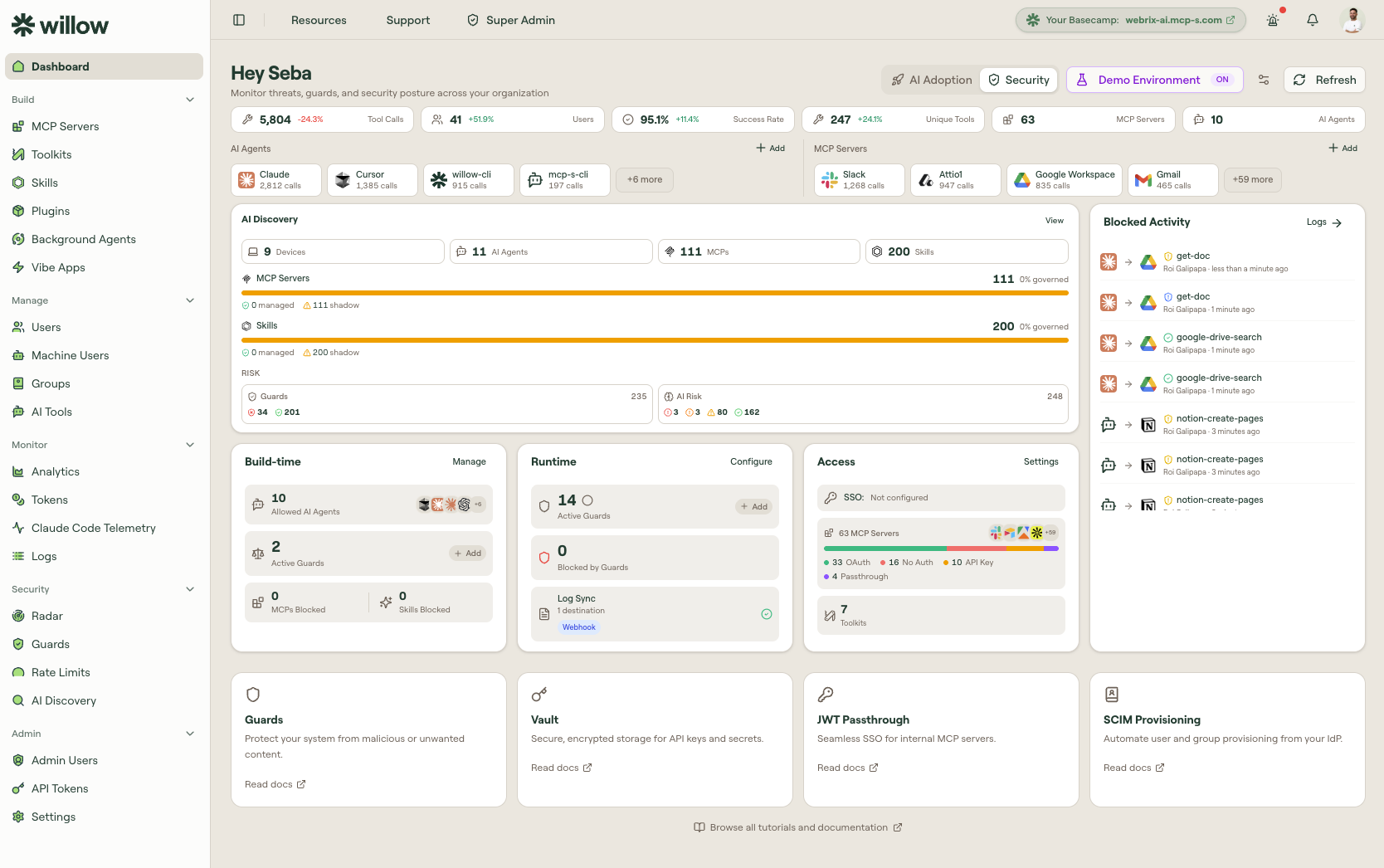
Willow Admin Console
Managed access control plane. Employee self-service, machine users, IT approval workflows, and 5,000+ employee deployments.
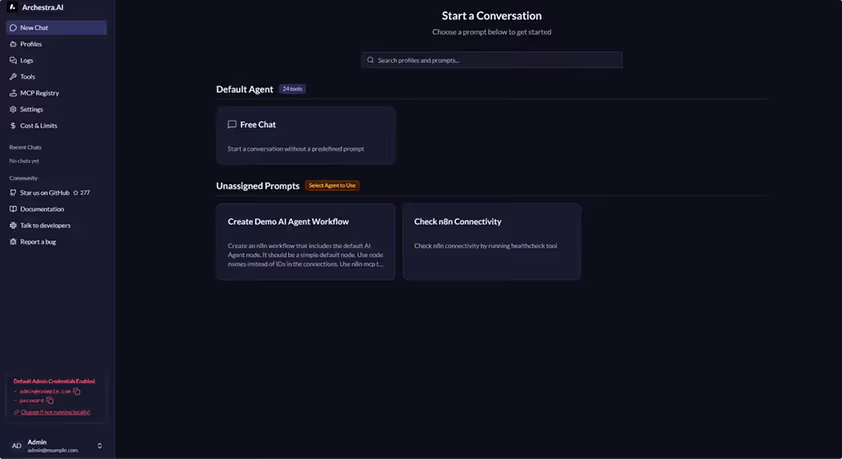
Archestra Control Plane
Open-source K8s-native platform. 858+ MCP servers, Dual LLM prompt injection protection, Prometheus/OpenTelemetry observability.
The Bottom Line
Archestra is open-source with 858+ MCPs and innovative AI security (Dual LLM, Dynamic Tools). Willow is a managed platform with employee self-service, machine users, and IT workflows battle-tested at scale.
Best for Willow
Enterprises needing managed deployment with employee enablement and machine users.
Best for Archestra
K8s teams wanting open-source with extensive MCP catalog and advanced AI security.

Key Differentiator
Willow offers managed deployment with employee self-service and machine users. Archestra provides open-source K8s infrastructure with Dual LLM security.
Feature Comparison

Who Each Solution Is Best For
Willow is Best For
Enterprises needing managed deployment with employee enablement. Ideal if you:
Best for Archestra
K8s teams wanting open-source with extensive MCP catalog and advanced AI security.

Deployment & Infrastructure
Managed platform vs. self-hosted K8s infrastructure.
Willow offers managed deployment:
- SaaS or On-Prem: SOC 2 compliant, no K8s required
- Air-Gapped: Fully isolated environments supported
- Rapid Setup: Deployments completed in days
- Managed Updates: Vendor handles infrastructure
Archestra provides K8s-native deployment:
- Kubernetes Production: Helm charts, 45ms p95 latency
- Terraform Provider: Infrastructure-as-code automation
- Open Source: Full source code access
- Self-Managed: You handle cluster ops and updates
Bottom Line
Both let you run agents, but they optimize for different things. Runlayer optimizes for building agents quickly. Willow optimizes for governing autonomous agents, giving each one its own scoped identity, least-privilege access, and full audit, so security can say yes to unattended work.

Security & Access Control
Enterprise identity vs. AI-specific security features.
Willow delivers enterprise identity:
- Quick-Start SSO: Okta, Entra, JumpCloud guided setup
- SCIM Provisioning: Automated user lifecycle
- Machine Users: Service accounts for CI/CD
- IT Workflows: CISO approval, sandboxed testing
Archestra provides AI-specific security:
- Dual LLM Protection: Two-agent prompt injection defense
- Dynamic Tools: Auto-restricts capabilities on untrusted content
- Tool-Call Policies: Per-tool access control
- HashiCorp Vault: Secrets with auto-rotation
Bottom Line
Both let you run agents, but they optimize for different things. Runlayer optimizes for building agents quickly. Willow optimizes for governing autonomous agents, giving each one its own scoped identity, least-privilege access, and full audit, so security can say yes to unattended work.

Connectors & MCP Library
Catalog size and customization approaches differ.
Willow provides curated connectors:
- 100+ MCPs: Slack, Jira, GitHub, Notion, Linear
- API-to-MCP: Convert any REST API instantly
- Employee-Driven: Teams propose new MCPs
- Version Control: Track with rollback
Archestra provides extensive catalog:
- 858+ MCPs: Largest open-source catalog
- Private Registry: Add third-party MCPs
- Private Registry: Add third-party MCPs
- Trust Levels: IT-verified indicators
- Version Control: Full rollback capabilities
Bottom Line
Both let you run agents, but they optimize for different things. Runlayer optimizes for building agents quickly. Willow optimizes for governing autonomous agents, giving each one its own scoped identity, least-privilege access, and full audit, so security can say yes to unattended work.

Employee Experience
Self-service adoption vs. chat-centric interface.
Willow enables self-service:
- Employee Portal: Browse MCPs, toolkits, prompts
- One-Click Connect: Cursor, Claude, VS Code instantly
- Machine Users: Agent-to-agent automation
- No IT Bottleneck: Self-service discovery
Archestra provides chat interface:
- ChatGPT-like UI: Intuitive for all users
- Multi-Model: Claude, GPT-4, Gemini, open-source
- Prompt Registry: Share prompts org-wide
- Built-in Chat: No external AI clients needed
Bottom Line
Both let you run agents, but they optimize for different things. Runlayer optimizes for building agents quickly. Willow optimizes for governing autonomous agents, giving each one its own scoped identity, least-privilege access, and full audit, so security can say yes to unattended work.

Management & Observability
Enterprise analytics vs. cloud-native observability.
Willow delivers enterprise management:
- Usage Analytics: Track by team, tool, use case
- Audit Trails: Complete compliance logs
- Cost Visibility: Token usage monitoring
- Policy Management: Per-agent, per-MCP guardrails
Archestra provides cloud-native observability:
- Prometheus Metrics: LLM tokens, request duration
- OpenTelemetry: Distributed tracing per call
- Grafana Dashboards: Pre-configured monitoring
- Cost Optimization: Auto model switching (96% savings)
Bottom Line
Both let you run agents, but they optimize for different things. Runlayer optimizes for building agents quickly. Willow optimizes for governing autonomous agents, giving each one its own scoped identity, least-privilege access, and full audit, so security can say yes to unattended work.
Why enterprises pick Willow
.png)
Asaf Yonay

84% / 91%
FAQS
Everything you need to know about Willow compared to Archestra
Compare Willow to other platforms
Go deeper on Willow
Your agents are already in the wild.
Give them a Basecamp. Go from AI chaos to AI work, in minutes.
