


What Is Shadow AI? Risks, Examples, and How to Govern It

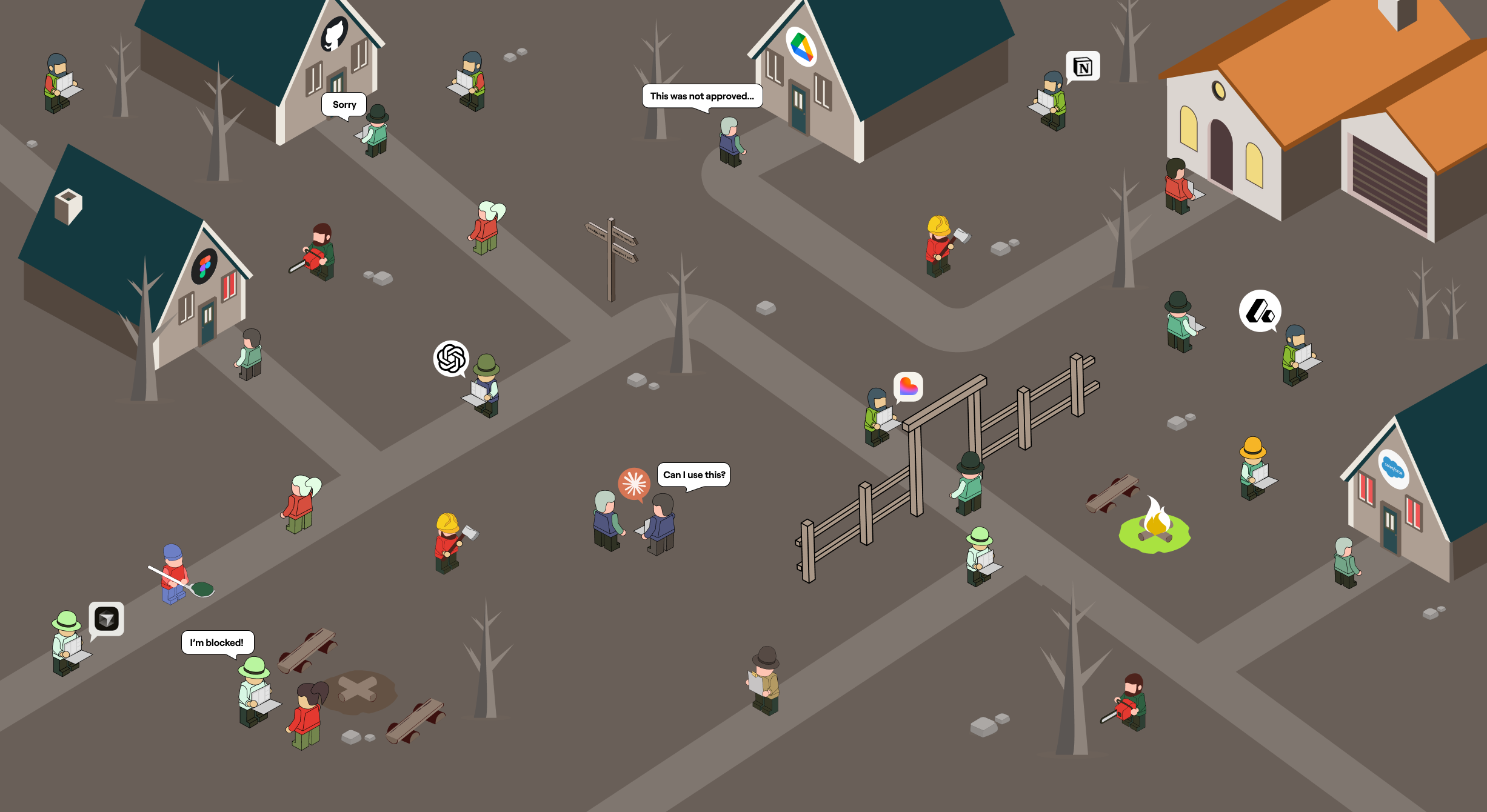
Shadow AI is the use of AI tools, agents, and connections inside an organization without the knowledge, review, or approval of IT and security. It is the AI your security team cannot see: the personal ChatGPT account wired into company data, the agent a developer spun up last week, the unmanaged MCP server quietly connecting an AI assistant to your production systems.
It is also already inside almost every enterprise. Generative AI adoption by employees climbed to 96% in 2024, and more than a third of employees admit to sharing sensitive work information with AI tools without permission (IBM / Infosecurity Magazine, 2024). The tools moved faster than the policies. This guide explains what shadow AI is, why it spreads, the risks it creates, and how to get it back under control without killing the productivity people are chasing.
What is shadow AI, exactly?
Shadow AI covers any AI usage that bypasses official oversight. That includes:
- Employees using unapproved AI apps like ChatGPT, Claude, Gemini, or DeepSeek for work tasks.
- Personal AI accounts connected to company data and SaaS tools.
- AI agents and automations deployed by individual teams without security review.
- Unmanaged MCP servers and plugins that connect AI assistants to internal systems.
- Vibe-coded apps and scripts shipped by non-engineers using AI coding tools.
The common thread is not the tool. It is the absence of governance. Nobody scoped what the AI can access, nobody is logging what it does, and nobody approved the connection to sensitive data.
Shadow IT vs. shadow AI vs. shadow agents
Shadow AI is the next chapter of a familiar story, and the chapters keep escalating.
Shadow IT was unapproved software and hardware: personal cloud storage, an unsanctioned project tool, a SaaS app bought on a credit card. The risk was data sitting somewhere IT did not control.
Shadow AI narrows to AI-specific tools. The risk grows, because employees do not just store data in these tools, they feed sensitive information into models whose training, retention, and output behavior the company never vetted.
Shadow agents are the 2026 escalation, and the most serious one. An agent does not just read data. It takes actions. It calls APIs, writes to databases, sends emails, and triggers workflows using real credentials. A shadow agent is an unmanaged identity with hands, operating inside your environment with nobody watching what it touches.
Each step adds capability, and capability is exactly what makes the exposure worse.
Why shadow AI spreads
Shadow AI is not a discipline problem. It is a math problem. The upside is immediate and personal, and the friction to do it the official way is high.
Employees reach for ungoverned AI because it makes them faster. They automate the boring parts of their job, draft in seconds, and solve problems in real time instead of waiting. When the approved path means a multi-week IT ticket and the unapproved path means pasting into a browser tab, people choose speed. Most are not trying to create risk. They are trying to hit a deadline.
The tools make it effortless. Almost every capable AI app is one signup away, no install, no procurement, no approval. The same accessibility that drives adoption is what makes shadow AI invisible. Security never gets a signal that the connection happened.
The real risks of shadow AI
The productivity gains are real. So is the exposure, and it shows up in four ways.
Data leakage
The most immediate risk is sensitive data walking out the door. An employee pastes customer records, source code, or a confidential contract into a model the company never vetted, and that data is now outside your control. With agents and connected accounts, the leak does not even need a human in the loop. An over-permissioned agent can pull from systems it should never have touched.
Compliance exposure
Regulated industries cannot afford ungoverned data flows. GDPR penalties alone reach up to 4% of global annual revenue, and newer regimes like the EU AI Act are adding obligations on high-risk AI use through 2026. Shadow AI means data crossing boundaries with no audit trail to prove what happened, which is the opposite of what every auditor wants to see.
Security vulnerabilities
Ungoverned AI expands your attack surface in ways traditional controls miss. Unmanaged MCP servers often store credentials in plaintext and run with broad permissions. Prompt injection can manipulate an agent into misusing access it already has, no malware required. Your DLP and IAM were built for humans and SaaS, not for autonomous agents acting on their own.
Unreliable and unaccountable output
When AI use is invisible, so is its quality. Teams make decisions on unverified model output, publish content that never passed review, and ship code nobody audited. And when something goes wrong, shared accounts and unscoped agents make it nearly impossible to answer the basic question: which AI did this, and what was it allowed to do?
Shadow AI examples
Shadow AI looks ordinary, which is why it slips through. A few common patterns:
- Sales connects a personal Claude account to the CRM to summarize accounts, exposing pipeline data to an unvetted tool.
- Marketing runs campaign data through an AI tool that mishandles customer information under data-protection rules.
- Engineering stands up an MCP server linking an AI assistant to GitHub and internal APIs, with no security review.
- Operations builds a vibe-coded internal app and publishes it to production without an audit.
- Support pastes customer messages into a chatbot to draft replies, leaking PII into a system with unknown retention.
None of these people are acting maliciously. Every one of them is creating an unmanaged access path.
How to manage and govern shadow AI
You cannot ban your way out of shadow AI. Blanket bans push usage onto personal devices and take your visibility to zero. The organizations getting this right are not the ones saying no. They are the ones building a faster path to yes. That takes four things.
- Discover what already exists. You cannot govern what you cannot see. Start with continuous discovery of every AI tool, agent, browser extension, and MCP connection in the environment, including the ones nobody told you about.
- Give every agent an identity and scope. Stop treating agents as extensions of human users on shared credentials. Give each one its own identity, scoped to exactly the tools and data its task needs, so least privilege is the default.
- Enforce guardrails at runtime. Evaluate what an AI is doing as it acts, not just whether it was approved at signup. Route high-risk actions to human approval. Let low-risk, routine actions run.
- Offer a governed path to yes. Give employees an approved, self-serve way to connect the AI they want, with security policy applied automatically. When the safe path is also the fast path, shadow AI stops being worth the risk.
The goal is not to slow AI down. It is to make the governed option the obvious one.
Where Willow fits
Most companies try to cover shadow AI by stacking point tools: a scanner here, a gateway there, a DLP bolt-on, a homegrown approval script. Seven tools that each see a slice and miss the seams.
Willow is the Agentic Access Platform, one control plane for every AI agent, tool, MCP, and skill in the enterprise. It discovers the AI already running across your org, gives every agent a scoped identity tied to a human, enforces guardrails at runtime, and keeps a full audit trail behind every action. Security sets policy once. Employees get a self-serve, governed path to the AI they want. In production at Wix, Willow governs around 600 tools and MCPs across roughly 5,000 weekly active users.
Shadow AI is already in your org. The only real question is whether you can see it.
FAQ
What is shadow AI?
Shadow AI is the use of AI tools, applications, agents, and connections inside an organization without the approval or oversight of IT and security. It ranges from employees using unapproved chatbots to autonomous agents and MCP servers deployed without review.
What is the difference between shadow IT and shadow AI?
Shadow IT is any unapproved software or hardware. Shadow AI narrows to AI-specific tools and adds new risks: sensitive data fed into unvetted models, and, in its most serious form, autonomous agents that take actions using real credentials without oversight.
What are the main risks of shadow AI?
The four biggest are data leakage, compliance exposure, security vulnerabilities from over-permissioned agents and unmanaged MCP servers, and unaccountable AI output that nobody reviewed.
Can you just ban shadow AI?
Banning rarely works. It pushes AI use onto personal devices and removes all visibility. A governed path to approved AI, with discovery, scoped access, and runtime guardrails, controls the risk without losing the productivity.
How do you detect shadow AI?
Through continuous discovery across the environment: identifying every AI app, agent, browser extension, and MCP connection in use, including unmanaged ones, so security can scope and govern them instead of guessing.
Background Agents in the Enterprise
Most teams can spin up an agent. Few can deploy one their security team signs off on. Here's the framework that does both.
FAQS
Everything you need to get your Basecamp running.


Your agents are already in the wild.
Give them a Basecamp. Go from AI chaos to AI work, in minutes.
