


Best Agentic Data MCPs in 2026, and How to Control Them

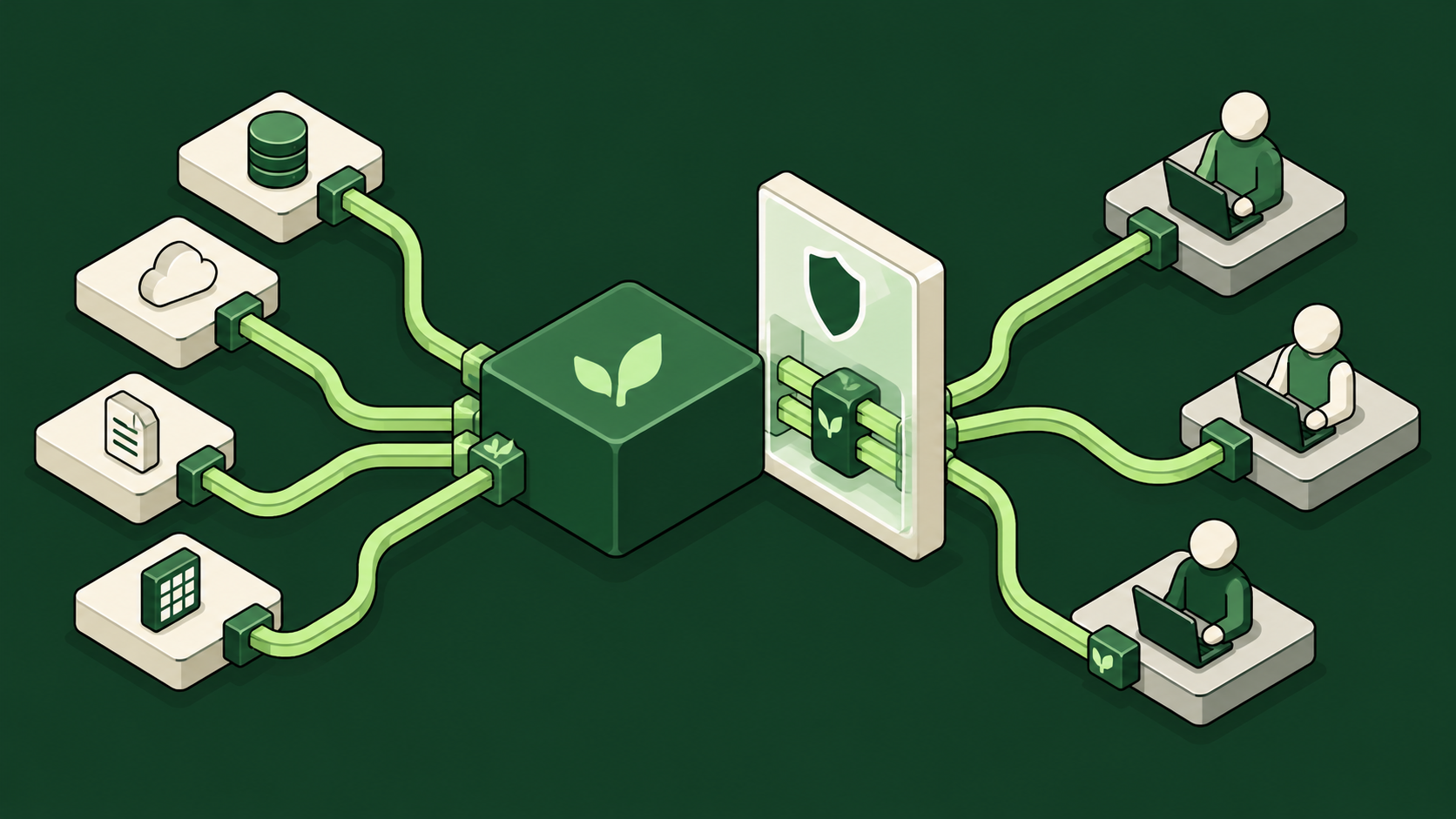
The best MCP server for agentic data is the one that enforces your existing access model on the agent, not the one with the most tools. Snowflake, BigQuery, and Databricks lead for warehouse data because they inherit native roles and IAM. MongoDB and Supabase lead for application data, with real limits in production. Google's MCP Toolbox covers many databases from one open-source server. Keewano is the newest entry, built for agents that reason over event sequences.
Every one of them can read your data. The question that decides whether you sleep tight is what each one stops an agent from doing, and who can see it happen.
TL;DR
- Warehouse data: Snowflake-managed MCP, BigQuery remote MCP, and Databricks Unity Gateway MCPs. All three tie agent access to roles you already manage.
- Application databases: MongoDB MCP Server and Supabase MCP. Both ship a read-only mode. Both warn you not to point agents at production without more controls.
- One server, many databases: Google MCP Toolbox for Databases (open source).
- Agent-native event data: Keewano. A database and MCP layer built for agents reasoning over ordered event histories. Out of stealth in September 2026.
- The gap: each server enforces access its own way. None gives you one identity, one policy layer, and one audit trail across all of them. That is the control plane problem.
What "agentic data" means
Agentic data access is an AI agent querying enterprise data on its own, mid-task, with questions nobody pre-defined. A dashboard answers a known question. An agent asks a new one every minute.
That changes the risk. A human analyst runs a handful of queries. An agent can run thousands, chain them, and act on the result. So the MCP server in front of your data is no longer a convenience. It is a security boundary.
How we evaluated them
Every claim below comes from the vendor's own documentation, checked in October 2026. We scored each server on four questions.
- Identity. Does the agent act as a real user or role, or as a shared service account?
- Scope. Can you limit tools, datasets, and operations, or is it all or nothing?
- Write protection. Is there a real read-only path, and is it on by default?
- Visibility. Can you see what the agent asked and what came back?
Comparison at a glance
The 7 MCP servers, one by one
1. Snowflake-managed MCP server
Best for: teams whose data already lives in Snowflake and whose governance already runs on Snowflake roles.
Snowflake hosts the server for you. Authentication uses Snowflake OAuth by default, or External OAuth so clients authenticate against your own identity provider, such as Okta or Microsoft Entra ID. Access to the server and each tool is controlled with role-based access control, which governs what a client can discover and invoke.
The part worth reading twice: Snowflake's own docs say tool annotations are client-facing hints, not security controls, and tell you to use RBAC and least privilege to limit what the underlying function or agent can do. Each server supports a maximum of 50 tools, and Snowflake notes that higher tool counts can degrade tool-selection accuracy.
The catch: sessions run under the connecting user's default role. If that role is broad, the agent is broad.
2. BigQuery remote MCP server
Best for: Google Cloud shops that want agents querying BigQuery under IAM.
Google runs the BigQuery MCP server as a remote endpoint. To use it, you grant the MCP Tool User, BigQuery Job User, and BigQuery Data Viewer roles on the project. There is a dedicated execute_sql_readonly tool for read-only queries. Google's docs state that execute_sql is the only tool that is not read-only, and that you can restrict it with an IAM deny policy.
The catch: read-only is something you configure, not a default. Without the deny policy, an agent with the right roles can reach the write-capable tool.
3. Databricks managed MCP servers
Best for: lakehouse teams already governed by Unity Catalog.
Databricks provides MCPs in the system.ai schema. Each one is a Unity Catalog securable invoked through Unity Gateway, so you govern who can call it with grants and govern individual calls with policies. For natural-language analytics, Databricks recommends the Genie One MCP, which resolves business terms through a governed semantic layer instead of letting the agent write SQL against raw tables.
The catch: governance depends on which endpoint you use. Databricks documents that the Genie Agent endpoint and the older workspace endpoints bypass Unity Gateway, so they do not appear in its tracing tables and do not support MCP-level grants or policies. Some system.ai MCPs, including the SQL one, sit behind a Unity Gateway beta.
4. MongoDB MCP Server
Best for: document data and Atlas, especially analysis against a replica or analytics node.
MongoDB's --readOnly option restricts the server to read, connect, and metadata operations. By default, read-only mode is off and the server allows writes. MongoDB's guidance is to enable the flag and connect with a dedicated read-only database user, and never to use write credentials with the server.
The security page is unusually direct about authentication. The server does not provide inbound authentication or authorization itself, so a remote deployment needs a proxy in front of it. MongoDB recommends OAuth 2.1 delegation and calls user impersonation and pass-through authentication anti-patterns, because they hide that an agent is acting and leak credentials to intermediate systems.
The catch: the safe setup is a design you build, not a switch you flip.
5. Supabase MCP server
Best for: building and testing apps on Postgres, with development or staging data.
Supabase ships read-only mode, project-scoped mode, and feature groups to limit which tools the model can use. Its own security write-up is the most candid in this list. Even in read-only mode, prompt injection remains the number one concern: hidden instructions inside database content can push an agent to expose data, even with Row Level Security enforced. Supabase says its guardrails reduced the risk but did not eliminate it, and that the safest approach is to never connect agents directly to production data.
The catch: treat it as a development integration. Supabase recommends non-production data, manual approval on tool calls, and logging every query.
6. MCP Toolbox for Databases (Google, open source)
Best for: platform teams that want one server across many databases and are happy to run it.
MCP Toolbox for Databases is an open-source server from Google. It lists support for AlloyDB, BigQuery, Cloud SQL, Spanner, Firestore, PostgreSQL, MySQL, SQL Server, Oracle, MongoDB, Redis, Elasticsearch, CockroachDB, ClickHouse, Snowflake, Trino, and more. It handles connection pooling, integrated IAM authentication, and OpenTelemetry observability out of the box.
The catch: you host it, you patch it, and you define each tool in configuration. Flexibility is the point, and also the operational cost.
7. Keewano
Best for: product, analytics, and AI teams whose agents need to reason over what happened in what order.
Keewano is a database built for what it calls machine reasoning. Instead of rows and pre-computed aggregates, KeewanoDB stores each entity's events together and in order, so an agent can ask questions like which users are on the same path as the ones who churned last month, without anyone building a pipeline for that question first. The company came out of stealth on September 15, 2026, with a $12 million seed round led by Hetz Ventures, according to CTech.
The MCP layer is the part that matters here. Keewano MCP is a remote server over Streamable HTTP, authenticated with a personal access token. It exposes analytics as structured tools: events and entities, reports and charts, similarity and pattern matching, outcome analysis, monitoring, and semantic definitions. Common questions such as retention, funnels, and KPIs take a single tool call. For harder questions, agents run custom logic inside the database, in a sandbox with time and memory limits.
On control, Keewano's own page says you can define access by agent, service, project, database, and environment, limit which data and tools an agent can use, keep an audit record of its activity, and monitor the cost and volume of agent-driven queries. The documentation describes performance claims as vendor-reported: a quarter-billion events scanned in under half a second in internal benchmarks, and up to 84% fewer LLM tokens in production workloads.
Pricing, from its pricing page: Free at $0 (up to 3M events per month, 25 MCP tool calls per day). Paid plans start at $149 per month billed annually ($213 monthly) with unlimited MCP tool calls, and SSO/SAML arrives at the Scale tier. Pricing scales with monthly active entities, not event volume.
The catch: it is a new product with a focused job. It is the right pick when the question is behavioral and sequence-based. It is not a replacement for your warehouse, and Keewano positions it to run alongside the stack you already have.
How to choose
Match the server to the data and the failure mode you cannot afford.
- Data already in a warehouse with mature roles? Use that vendor's managed server and spend your effort on the role design.
- Application database? Read-only mode plus a read-only database user plus non-production data first.
- Many databases, strong platform team? MCP Toolbox, with the operational work budgeted.
- Agents that must investigate behavior over time? Evaluate Keewano on a free plan against a real event stream.
The control gap all seven share
Line the seven up and a pattern shows. Snowflake uses roles. BigQuery uses IAM deny policies. Databricks uses Unity Catalog grants. MongoDB asks you to build a proxy. Supabase asks you to keep agents off production. Each is correct on its own terms. Together they leave a CISO with five permission models, five audit formats, and no single answer to "which agents touched which data last Tuesday."
Three problems repeat:
- Identity fragments. Agents authenticate as service accounts, personal tokens, or default roles. Few map cleanly to a named employee.
- Scope is set per server. Least privilege has to be rebuilt in every system, by a different team.
- Prompt injection ignores read-only. Read-only blocks writes. It does not stop an injected instruction from making an agent read sensitive tables and surface them.
This is the layer Willow sits in. Willow is the access layer for AI agents: one MCP gateway between any agent and any of these servers, with identity inherited from your IdP, app-aware scoping per tool and per action, human approval for risky calls, and an audit trail tied to a real employee, streamed to your SIEM. It does not replace the controls in Snowflake or BigQuery. It makes them enforceable from one place, and it finds the MCP servers developers installed without asking.
Wix runs this in production: about 5,000 weekly active users, around 600 governed tools and MCPs, and more than 2M governed tool calls every week.
FAQ
What is the best MCP server for data access?
There is no single best. For warehouse data, the managed servers from Snowflake, Google BigQuery, and Databricks are the strongest fit because they inherit native roles, IAM, or Unity Catalog grants. For application databases, MongoDB and Supabase offer read-only modes. For many databases from one server, MCP Toolbox is the open-source option.
What is agentic data?
Agentic data is data an AI agent queries autonomously, mid-task, with questions that were not defined in advance. It differs from dashboard data because the agent decides what to ask, how often, and what to do with the answer, which makes access control and auditing far more important.
Is a read-only MCP server safe?
Read-only reduces risk but does not remove it. It stops an agent from changing data. It does not stop prompt injection from making an agent read sensitive data and expose it. Supabase states this directly: even in read-only mode, prompt injection remains the top concern. Pair read-only with least-privilege roles, non-production data where possible, and approval for sensitive calls.
What is Keewano MCP?
Keewano MCP is a remote Model Context Protocol server that gives AI agents direct access to Keewano Analytics, which runs on KeewanoDB, a database that stores events in sequence per entity. Agents use it to run reports, compare behavior, and monitor patterns over live event data. Connection uses a personal access token over Streamable HTTP.
How do I govern agent access to data across several MCP servers?
Put a control plane in front of them. Each data server enforces access its own way, so you need one layer that gives every agent an identity from your IdP, scopes what it can do per tool, routes risky calls to a human for approval, and writes one audit trail. That is what an MCP gateway like Willow provides.
Can I run these servers in production?
Some vendors say not to, at least by default. Supabase recommends non-production data. MongoDB recommends read-only users and a proxy for remote deployments. Snowflake, BigQuery, and Databricks are built for production but only as safe as the roles and policies you set.
Background Agents in the Enterprise
Most teams can spin up an agent. Few can deploy one their security team signs off on. Here's the framework that does both.
FAQS
Everything you need to get your Basecamp running.


Your agents are already in the wild.
Give them a Basecamp. Go from AI chaos to AI work, in minutes.
