


Best MCP Gateways for Enterprise AI Teams in 2026

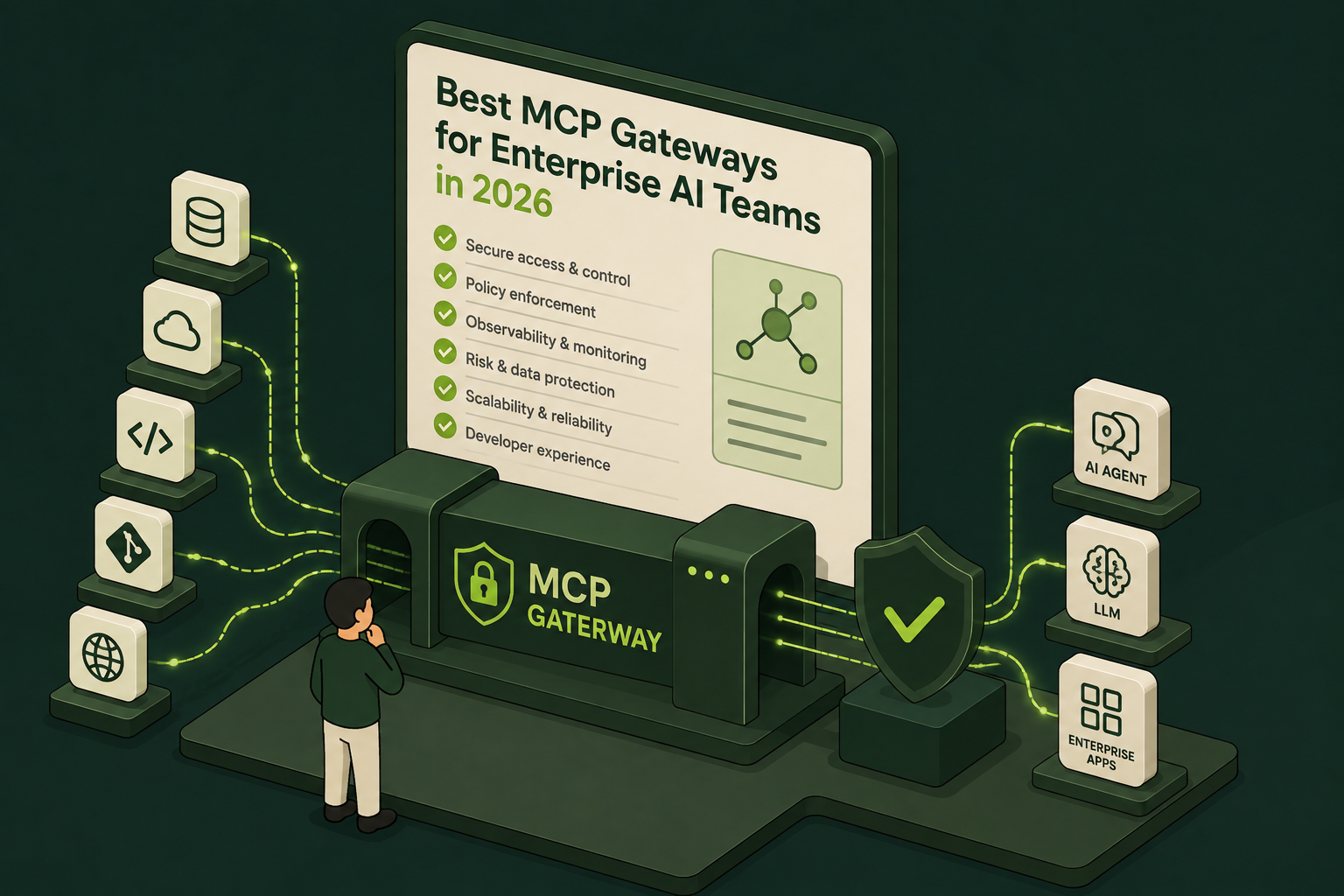
An enterprise standing up AI agents this year runs into the same wall: dozens of agents, each wired to internal tools, with no single place to say what any of them is allowed to do or to see what they already did.
The fix has a name now, it’s called an MCP gateway.
If you’re in the market for one, this is a buyer's guide for you.
Willow builds an identity and access layer for AI agents, so we have a stake here, and we will say plainly where Willow fits and where it does not.
But the field holds strong tools built by serious teams.
The aim is to help an enterprise pick the right MCP gateway for its specific situation, even when that turns out not to be Willow.
If you’re new to the terminology or the solution, an MCP gateway is a single control point that sits between every AI agent and every tool that agent connects to.
MCP stands for Model Context Protocol. It’s an open standard that lets an agent discover and call tools in a uniform way. Similar to an API.
It’s built to move data between an AI agent and a tool. But nothing more. The base protocol enforces no authentication or authorisation by default. HTTP transport carries optional OAuth, but most MCP deployments skip it.
This leaves significant governance gaps, and a large space for things to go wrong in your org. The risk compounds because AI agents can make sweeping changes, edits, and removals across an entire tech stack in seconds.
An MCP gateway is the layer that:
- Authenticates each connection
- Decides what the agent is allowed to do
- Records every call
Enterprises deploying AI agents at any meaningful scale need some form of this to deliver AI safely, within the limitations of their regulatory environment.
What is an MCP gateway, and why does an enterprise need one?
An MCP itself simply standardizes the wiring between AI agents and apps. By default, the protocol authenticates nothing and keeps no record of what ran. HTTP transport carries optional OAuth, but most deployments skip it. A malicious tool has no checkpoint.
In short, it adds all of the capability to AI systems, but little of the governance. That left enterprises with full capability and no governance, which is the problem MCP gateways were built to solve.
An MCP gateway is the control panel for every connection between your AI agents and their tools. It decides who can connect, what they can do, and keeps a record of everything that ran.
Without a gateway, every agent-to-tool connection is wired with credentials scattered across config files. There is no central place to see or stop anything.
The sprawl is already large, and growing.
Non-human identities (the software accounts that agents, service accounts, and API keys run as) already outnumber human ones 45 to 1 on average. Up to 144 to 1 in cloud-native environments (Cloud Security Alliance, May 2026).
Wire ten agents to ten tools by hand and you have a hundred ad-hoc connections, each with its own auth and its own blind spots.
A gateway collapses those hundred connections into a hub-and-spoke model. Every agent connects to one governed entry point, and the gateway connects to the tools.
Enforcing policy and maintaining reliable audit trails and logs is now possible.
Two main forces are driving MCP gateway adoption
While the core reason for deploying an MCP gateway is to bring some level of control to AI agent workloads and their connections to external tools, there are two other driving forces compelling enterprise adoption.
One is shadow AI, the other, regulation.
Shadow AI is when your employees are running agents and tools nobody approved. One in five organizations has already suffered a breach caused by it (IBM Security / Ponemon Institute, 2025).
Even so, 97% of organizations hit by AI-related breaches lacked proper AI access controls (IBM Security / Ponemon Institute, 2025).
Shadow AI looks like your employees using AI in browsers, on their personal devices, or linked to personal credit cards for company work.
Without the right tooling, you may never know it is happening.
Hence the name, shadow AI.
Companies with high shadow AI use had breach costs averaging $670,000 more than organizations with little or no shadow AI use (IBM Security / Ponemon Institute, 2025).
Regulation is the second driving force, and only magnifies the need to gain visibility and control over shadow AI use.
The EU AI Act's transparency obligations (Art. 50) apply from 2 August 2026. Record-keeping, logging, and human oversight for Annex III high-risk AI systems apply from 2 December 2027 (Gibson Dunn, 2026).
That means audit-grade logs are no longer a nice-to-have for any AI agent touching regulated data.
And you have two categories of agents touching that data. One you know about. And the other, in the shadows.
For most enterprises the gateway is now a must-have. The open question remains which one, and based on what criteria.
How to evaluate an MCP gateway: the criteria that separate them
Six key things decide which MCP gateway is right for your organization.
The decision rests on your needs and existing tooling across:
- Identity
- Access-control depth
- MCP-specific threat handling
- Audit and compliance
- Deployment flexibility
- Open source versus commercial
What separates vendors more than any other aspect is how deep their control goes and what they secure against.
Does the gateway give each agent a real, accountable identity?
The strongest gateways tie every agent to an accountable identity. No anonymous keys.
An agent running on a shared API key or a free-floating service account that nobody can trace back to a person is a governance issue. There is no accountability. Nor is there any possibility to decouple an agent from its owner when they leave the company, because you simply don’t know who is responsible for it.
Secure implementation looks like an AI agent that inherits its identity from a real employee through the identity provider (the system like Okta or Microsoft Entra ID that already answers "who is this and what are they allowed to do") your organization already runs.
Inherited identity and permissions is what makes accountability and clean offboarding possible. It is the most useful question most buyers never ask a vendor.
How deep does the access control go?
There are levels to access control. You can block certain apps, or block certain actions within those apps. The first level results in two kinds of errors (1) employees and AI agents lack access to tools they need, or (2) employees and AI agents have too much access, enabling them to cause serious irreparable damage.
Many providers stop short at the first level here, failing to enable granular permissions within individual apps.
Ask your vendor which category they fall into:
- Connection-layer control answers "can this agent reach this tool at all?" Almost every gateway does this, allowing or blocking a whole tool, like granting "Jira access."
- Action-layer control answers "what can this agent do once it is inside the tool?" with app-aware permissions granting "read tickets in Project X" instead of blanket Jira access.
Action-layer control is rare, and it is the layer that matters most. The costly incidents are almost always authorized agents doing something inside a tool they should never have been allowed to do.
Does it secure against MCP-specific attacks like tool poisoning?
The signature MCP attack is tool poisoning, when malicious instructions are hidden in a tool's description rather than its output.
Your AI agent connects, loads each tool's metadata into its context window (the working memory the model reads before it acts), and inadvertently ingests a poisoned description.
It happens before any tool even runs. All you (or your AI agent) need to do is install the tool.
MCPTox benchmark tested 45 live MCP servers and 353 real tools against poisoned descriptions (MCPTox, arXiv 2508.14925). They found:
- The highest refusal rate was under 3% (that’s the ceiling for how good AI agents are at refusing contaminated instructions)
- More capable models are more susceptible to attacks because they read them as legitimate instructions
- Such attacks had up to a 72.8% success rate in poisoning AI agents
Ask whether a gateway inspects tool definitions, not just prompts.
What does a real audit output look like?
Most gateways log tool calls at the connection layer and surface them in a dashboard. For a compliance audit, you need a record tied to a named employee, showing who authorized the agent, what it was permitted to do, what it actually did, and when.
The right setup streams tool-call events to Splunk, Loki, or Grafana and ships pre-built exports for SOC 2, GDPR, HIPAA, and ISO 27001.
With EU AI Act Annex III logging requirements set to apply from December 2027 for high-risk AI systems, months of unattributed agent activity is a gap worth closing (Gibson Dunn, 2026).
What deployment options does the platform support?
If your regulatory environment requires data to stay in a specific jurisdiction, some SaaS-only options may be off the table.
Lunar MCPX runs on shared cloud for the free and Pro tiers and self-hosted Kubernetes for Enterprise (Lunar pricing). Archestra and Obot are fully self-hosted. Willow supports SaaS, self-hosted, and full on-prem or air-gapped (Willow platform).
Open source or commercial: which fits your requirements?
Open source gives full code visibility and no vendor lock-in. But patching, scaling, incident response, and more all fall to your team.
Four tools in this list offer open source solutions. These are Archestra (AGPL-3.0), Obot (MIT), Lunar MCPX (MIT), and MetaMCP (MIT).
AGPL-3.0 requires any modifications be contributed back to the project. MIT does not. If you are building internal tooling on top of whichever gateway you pick, that governs what you can do with the code.
None of the four in this list have published SOC 2 Type II, HIPAA, or ISO 27001 certifications for their open-source tiers. Lunar Enterprise is an exception (SOC 2 Type II, HIPAA, and PCI DSS) but that tier is paid.
The best MCP gateways for enterprise AI teams in 2026, compared
The best MCP gateway depends on your priorities, existing tech stack, and AI agent workloads. As well as your industry and specific regulatory requirements.
No single tool wins on governance depth, MCP-specific threat detection, open-source control, and platform breadth at once.
Willow: the Agentic Access Platform
Willow is an Agentic Access Platform. The MCP gateway is one component of that. Alongside it sit shadow-AI discovery, runtime guardrails, and a self-serve portal for the whole org.
Pick Willow when the priority is governing both which tools agents can reach, and what agents do inside a permitted tool.
Willow’s MCP gateway:
- Sits between every agent and every tool
- Handles authentication at the connection layer
- Enforces permissions at the action layer
- Logs every tool call
With it, you can route any MCP-compatible agent (Claude, Cursor, ChatGPT, and more) through one governed entry point (Willow Tools & Skills). The catalog covers 100+ governed connectors for enterprise tools like Jira, Salesforce, and GitHub, with 1,000+ integrations in the broader marketplace.
A self-serve portal means the whole org can connect their agents to approved tools without opening a ticket.
Shadow-AI discovery is native through endpoint sensors and a Chrome extension for browser AI use, covering important surfaces some other MCP gateways miss.
Browser use in particular is a common way shadow AI shows up in organizations, with employees using personal subscriptions to popular AI tools.
While most gateways control the connection, Willow enforces a three-level model, enabling you to define and control permissions at the connection level and the action level.
It gives you the power to decide not just "can this agent access Jira" but also "what can it read, create, reassign, or delete, and on which data" (Willow Identity & Access).
Most enterprises running AI agent workloads at any meaningful scale need some form of this granular permissions infrastructure.
Setting it up is made easy, because each AI agent inherits identity from a real employee through your existing identity provider (Okta, Entra ID, or JumpCloud).
SCIM (the standard that auto-provisions and offboards accounts) is built in, meaning you can revoke agent access the moment the employee leaves. That avoids one of the biggest pain points in AI enabled enterprises today.
The employee leaves, but their AI agents and MCP connections keep running, and workloads accumulate errors. Credentials stay live, and Ex-employees can sometimes re-enter production systems through connections that were never closed.
Willow’s audit logs integrate with Splunk, Loki, and Grafana. Pre-built exports cover SOC 2, GDPR, HIPAA, and ISO 27001.
It is also one of the most flexible in terms of how you deploy it within your company. Choose from SaaS, dedicated cloud, on-prem, or air-gapped (Willow platform).
Wix runs Willow across ~5,000 employees and ~600 tools, producing 300,000+ tool calls per week, every one tied to a real identity. Asaf Yonay, Head of AI Core at Wix attributes Willow to their successful AI adoption, saying “We are six to ten months ahead of most companies in AI adoption. More code to production, fewer incidents.” (Wix case study)
Willow is not without its limitations, though. The core platform is proprietary, not open source. Though it does have a free tier, teams that require a fully inspectable, self-owned stack will look at the open-source entries below instead.
Runlayer: MCP-specific threat detection
Runlayer is the strongest choice if real-time MCP threat detection is your top concern.
Its ToolGuard and ListGuard detectors run semantic analysis on MCP server metadata and tool definitions to catch:
- Tool poisoning
- Command injection
- Supply-chain attacks at the connection layer
- Prompt injection through tool schemas
The Runlayer team curates a catalog of 18,000-plus vetted MCP servers.
The platform is SOC 2 Type II, HIPAA, and GDPR compliant. If the threats you’re seeking to protect against are tool poisoning and supply-chain attacks, Runlayer is the right pick. It controls which tools an agent can reach but not what the agent can do once inside an app or tool like Linear, Datadog, AWS, or Supabase (Willow vs. Runlayer).
MintMCP: the compliance-first choice
MintMCP’s Virtual MCP architecture enables role-based permissions and curated tool sets per team.
When it comes to onboarding (and offboarding) employees, it is synced by SCIM meaning that when an employee leaves, their AI agents can be decommissioned smoothly (MintMCP).
MintMCP’s Agent Monitor traces every tool call made, and can be connected to coding agents like Claude Code and Cursor (MintMCP Agent Monitor).
The founding team includes Jiquan Ngiam and Vijay Vasudevan, who helped build TensorFlow and Coursera at Google (MintMCP About).
MintMCP is both SOC 2 Type II and HIPAA compliant (MintMCP Trust).
If SOC 2 Type II and HIPAA certification is what procurement needs, and you don't yet need to control what an agent does inside a specific tool like HubSpot or Stripe, then MintMCP is worth evaluating (Willow vs. MintMCP).
Cloudflare: the platform-scale option
For enterprises already running on Cloudflare's global network, extending into MCP governance is a natural addition to an existing deployment.
It is a strong fit for teams already building on its edge compute tooling.
Its AI Gateway, MCP servers, and Agents platform run on its powerful global network spanning 330-plus cities.
Managed OAuth enables agents to authenticate on behalf of users without insecure service accounts (Cloudflare Agents).
Cloudflare ships with SOC 2 Type II, ISO 27001, PCI DSS 4.0, and FedRAMP Moderate (Cloudflare compliance).
What it is not, however, is an agent-governance layer.
Cloudflare's MCP portals include mandatory IdP authentication and per-tool allowlisting, but stop short of per-action permission scoping inside tools.
Because Cloudflare is gateway-rule-based rather than endpoint-based, shadow MCP detection is limited.
If you’re already shipping with Cloudflare, it will probably account for a few of your requirements. Though you’ll likely need to layer in an additional solution or two to get the full coverage you need (Willow vs. Cloudflare).
Archestra, Obot, Lunar, and MetaMCP: the open-source field
Open-source gateways are the right call when self-ownership and inspectability matter most, outranking the benefits of managed compliance.
The four leading open source MCP gateway projects differ significantly in maturity and focus. There is also risk of projects being sunset, and no longer maintained. But if you’re already building on top of open source, you’re accustomed to this.
Archestra
Archestra stops prompt injection at the environment level before the model ever responds.
Its guardrails target what it calls the Lethal Trifecta, the three preconditions that combine to turn a prompt injection into a data exfiltration event (1) private data in scope (2) untrusted external content in the context window, and (3) an active outbound channel.
When all three line up, the guardrail fires before any model evaluation happens.
OAuth on-behalf-of flows run each tool as the authenticated user so every tool call traces back to a real employee.
The code is AGPL-3.0 licensed with full source visibility (Archestra). This means any modifications to the code must be released publicly (the project can't be quietly forked into a proprietary product.) For this reason, many enterprise companies flag AGPL as requiring legal review before use. Google bans its use outright.
For teams seeking prompt injection and data exfiltration prevention (and who can run the infrastructure themselves) Archestra is worth exploring.
Concept Ventures backed it with a $3.3M pre-seed so they have funding to continue development (Concept Ventures).
Obot
Obot covers the full MCP lifecycle in one platform (hosting, registry, gateway, and a built-in chat client.)
It is MIT-licensed and Kubernetes-native, built with GitOps workflows by the founding team behind Rancher Labs (acquired by SUSE) and Cloud.com (acquired by Citrix). Mayfield and Nexus Venture Partners put $35M behind them at seed (Obot).
Production deployments require Kubernetes, and access control is server-level RBAC. Teams already running Kubernetes get a platform that fits into existing GitOps and CI/CD pipelines without additional infrastructure overhead.
The built-in chat client extends the platform to reach non-engineers without handing anyone direct access to platform configuration, so governance covers every team running agent workflows (Willow vs. Obot).
Lunar MCPX
Lunar pairs two layers in one product. A tool-governance gateway for MCP traffic and an AI gateway for LLM traffic.
Its MIT-licensed free tier runs on a shared cloud for up to 50 users. Being MIT licensed means enterprises can modify and deploy without open-sourcing changes.
Access control at the tool level, rather than the in-tool action level. That means no control of what agents actually do inside apps like Figma, ServiceNow, Workday, HubSpot, or Stripe.
The Enterprise tier adds self-hosted Kubernetes, SSO, full RBAC, audit trails, and HashiCorp Vault integration (Lunar).
Boomi announced its intent to acquire Lunar in May 2026 (BusinessWire, May 2026). If the deal closes, Lunar becomes part of a larger integration platform vendor.
MetaMCP
MetaMCP aggregates multiple MCP servers into a single interface. Agents reach any server through one entry point, without per-agent server configuration.
It organizes connections using a Servers-to-Namespaces-to-Endpoints model and even ships its own GUI for managing server connections (MetaMCP).
MetaMCP provides routing infrastructure. It solves the multi-server aggregation problem with one entry point connecting agents to any MCP server, without per-agent configuration overhead. Identity management, audit depth, and compliance coverage will require a separate governance layer on top (Willow vs. MetaMCP).
The gap most MCP gateways share, and why it matters
The pattern across every vendor above is the same: connection-level control is standard; action-level control is rare. But very few control what the agent can do once inside.
Most costly agentic incidents trace to authorized agents doing something inside a tool they were never meant to touch.
If access is connection-level and both "read config" and "drop the database" sit behind the same open door, your governance strategy is simply hoping the AI agent doesn’t do anything it shouldn’t. Or an employee doesn’t direct it to do something it shouldn’t.
App-aware permission is the only way to keep the door open (and benefit from AI productivity gains) but remain protected against high-risk actions.
When defining your agent access permissions, ask three questions:
- Which tools can the agent connect to? The connection layer, the one almost every gateway already handles.
- What can it do inside each one? The action layer: read versus write versus delete, scoped to the task.
- Under what conditions, on which data, with whose approval? The context layer, where high-stakes actions pause for a human sign-off before they run.
And find an MCP gateway and AI agent governance layer that enables you to implement the permissions you need. Rather than letting a platform’s capabilities dictate how secure your AI agent systems can be.
Below is a quick decision-making rubric to help you narrow in on the right solution for you.
If you want to see app-aware permissions in practice, Willow's platform overview walks through the three-level model end to end (Willow platform).
Background Agents in the Enterprise
Most teams can spin up an agent. Few can deploy one their security team signs off on. Here's the framework that does both.
FAQS
An AI gateway governs traffic between your application and language-model providers; an MCP gateway governs traffic between your agents and the tools they call. An AI gateway handles model routing, caching, cost tracking, and rate limiting across providers like OpenAI and Anthropic. An MCP gateway handles a different problem: authenticating and authorizing each tool call an agent makes, and logging it. Some products do both, but they are distinct jobs, and a tool strong at one is often thin at the other. For agent governance, the MCP gateway is the layer that matters.
Open-source MCP gateways can be a strong fit when your team wants a fully inspectable, self-owned stack and has the operational capacity to run it. Projects like Obot, Archestra, Lunar MCPX, and MetaMCP are free to deploy and audit. The trade-offs are real: most lack formal compliance attestations like SOC 2 in their free or self-hosted tiers (Lunar Enterprise is an exception: SOC 2 Type II, HIPAA, and PCI DSS, though that tier is commercial), and several require Kubernetes expertise, and the operational and security burden sits with you. If your blocker is a procurement compliance checklist or a need for action-level permissions, a commercial platform usually closes that faster.
Tool poisoning is an attack where malicious instructions are hidden in an MCP tool's description rather than its output, so they reach the agent at connect time before any tool runs. Because the poison lives in metadata, ordinary prompt-injection filters never see it. Only gateways that inspect tool definitions and metadata defend against it; generic content filtering does not. If MCP-specific threats are a primary concern, ask a vendor directly whether it scans tool schemas and metadata, since not all do.
For regulated enterprises, the deciding factors are compliance attestation, audit-export depth, and air-gapped deployment, which narrows the field quickly. SOC 2 Type II attestation is the baseline most procurement teams require, and pre-built exports for GDPR, HIPAA, and ISO 27001 turn audit prep into a query. If you operate fully isolated environments, confirm the gateway offers a true air-gapped deployment, not only cloud or VPC, since several leading options stop at one or the other. With the EU AI Act's Annex III logging obligations applying from December 2027, building immutable audit trails now positions enterprises ahead of the compliance deadline.
Everything you need to get your Basecamp running.


Your agents are already in the wild.
Give them a Basecamp. Go from AI chaos to AI work, in minutes.
