


Grok Bot vs Other Autonomous AI Agents: How It Works, How It Compares, and How to Run It Safely

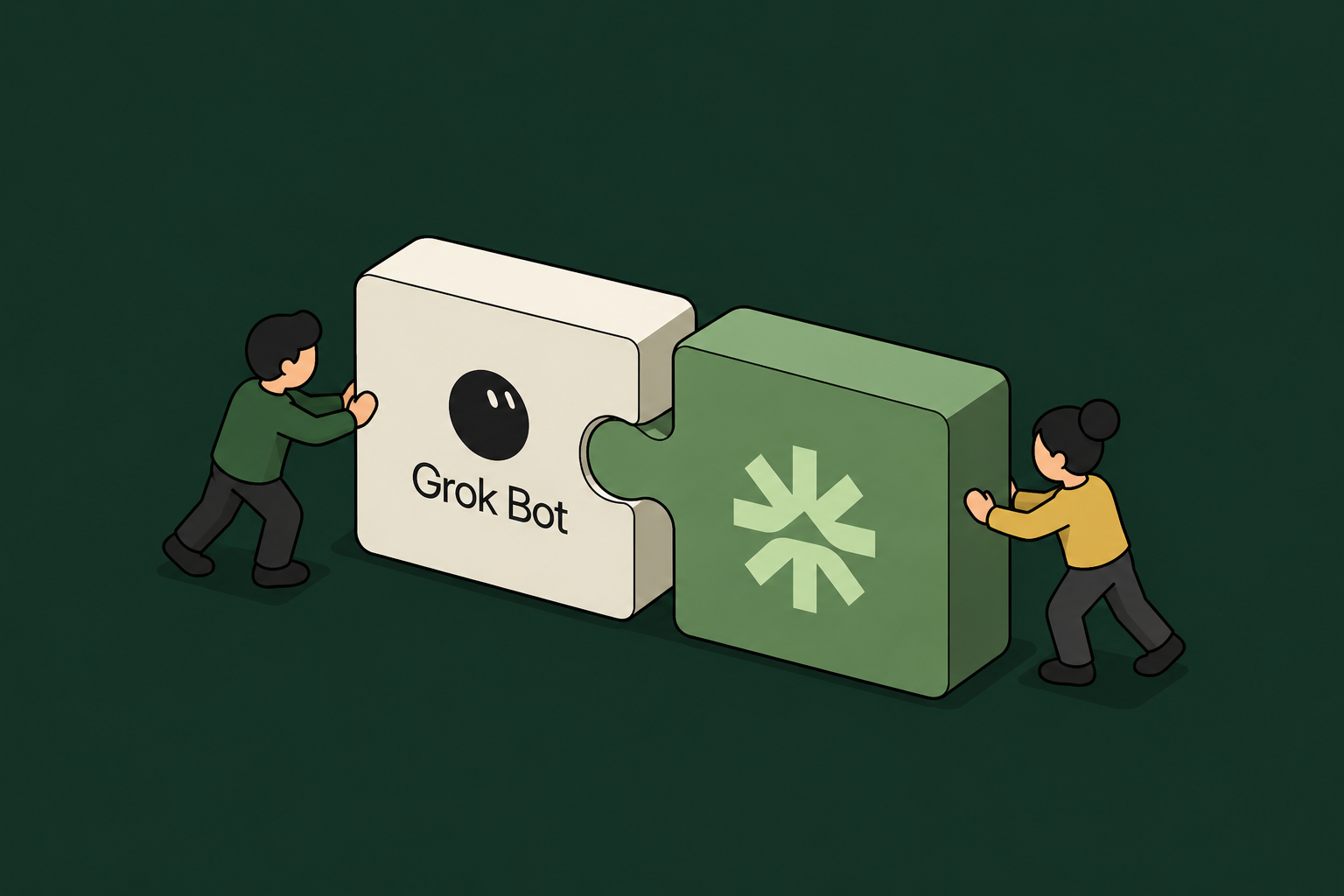
On August 11, 2026, xAI launched Grok Bot: a team of always-on AI agents that have their own computer, sign into the tools you already use, and work 24/7 until a job is done. It is the clearest sign yet that the market has moved past the chat assistant. The new unit of AI at work is not a prompt box, it is a teammate you hand a task to.
This guide explains what Grok Bot actually is, how it compares to the other autonomous agents enterprises are evaluating, and the question every one of them forces a security team to answer: how do you let an agent sign into your systems and act on its own without losing control of what it can touch.
What is Grok Bot?
Grok Bot is xAI's autonomous agent product, launched in early beta on August 11, 2026. Instead of answering inside a chat window, each Bot gets a computer of its own in the cloud, signs into your applications, and does multi-step work end to end, coming back only when something needs your approval.
The defining features, per xAI's launch:
- A computer of its own. Bots run on a shared cloud computer, so work does not stall when you close your laptop. They sign into apps, tools, and websites, including platforms with no clean API or MCP, and drive the interface the way a person would.
- Message it like a teammate. You hand off work in a chat thread from desktop or iOS. There are no workflows to build first.
- Teams of Bots. People run several Bots in parallel with a chief-of-staff Bot on top. Bots message each other, pass work, and pull a human in only for judgment calls.
- Learns by watching. Ask a Bot to follow along while you do a task once. It saves the steps as a routine and runs it on its own next time.
- Availability and pricing. Beta is open to SuperGrok Heavy ($300/month), Cursor Ultra ($200/month), and Cursor Premium Teams ($120/seat/month) subscribers, distributed through Cursor. Enterprise access is a waitlist as of launch.
The examples xAI showcases are ordinary enterprise work: a sales Bot updating the CRM from call transcripts and drafting follow-ups, an operations Bot seating new hires and processing invoices from Gmail, and an engineering Bot reproducing a bug in the UI, filing the ticket, and handing the fix to another Bot.
How Grok Bot works
The mechanism is what makes Grok Bot powerful and what makes it a governance question. A Bot logs into your tools once, then uses your apps and websites just like you would, including the ones that are hard to navigate or have no API. Because it runs on its own always-on cloud computer, it keeps working unattended, and because Bots can coordinate in group chats, one task can fan out across several agents acting at the same time.
Read that as a security leader and the picture sharpens. An autonomous, non-human worker is signing into your systems, often with a human's credentials, acting across apps around the clock, and driving interfaces directly where no API gate exists to check it.
Grok Bot vs other autonomous AI agents
Grok Bot enters a crowded field. Every major lab now ships an agent that plans and acts, not just answers. They differ most in where they run, how they reach your tools, and how much oversight they build in.
The honest reality check across all of them: autonomous agents are impressive and still imperfect. On the OSWorld 2.0 benchmark of realistic long-horizon computer-use tasks, a leading model with maximum reasoning fully completed only about 21% of them (OSWorld 2.0, 2026). That is not a reason to avoid these agents. It is the reason they need guardrails, approval gates, and an audit trail, because an agent that is right most of the time still acts on your systems the rest of the time.
Two contrasts matter most for an enterprise buyer. First, access model: Grok Bot's willingness to drive any interface, even without an API, is its superpower and its blind spot, because interface-level action is the hardest kind to govern centrally. Anthropic's Claude leans the other way, trading some raw autonomy for permission gating and a compliance trail. Second, enterprise readiness: several of these ship inside an enterprise plan with admin controls today, while Grok Bot's enterprise tier is still a waitlist, which means early adopters are running it on individual or team plans, outside central IT.
The governance gap this class of agent creates
Grok Bot is not uniquely risky. It is a clear example of a pattern every autonomous agent shares, and the pattern is what security teams have to govern.
- Borrowed identity. When a Bot signs in with an employee's credentials, its actions are indistinguishable from that person's. There is no separate, revocable identity for the agent, and no clean way to answer "which agent did this, on whose behalf."
- Standing access, 24/7. An always-on agent holds live sessions into your systems around the clock, long after the human who set it up has logged off.
- Interface-level reach. An agent that drives the UI directly, with no API in the path, slips past the API gateways and connectors most governance is built on.
- Fan-out. Teams of agents acting in parallel multiply every one of these exposures at once.
- Shadow adoption. With enterprise tiers waitlisted, employees adopt these agents on personal or team plans first. The open-source, self-hosted ones make this sharper still: an employee can stand up OpenClaw or Hermes on a $5 VPS, point it at any LLM, and let it write its own skills, entirely outside IT. Security often learns about them after they are already working inside the business.
This is the same root issue behind the OWASP Excessive Agency risk (LLM06): an agent with more access and autonomy than its task requires, and no boundary enforcing the difference. The productivity is real. So is the exposure, and it does not show up until someone asks what a specific agent touched last Tuesday.
How to run autonomous agents safely: Willow Background Agents
The answer is not to block this class of agent. Blocking pushes it onto personal devices and removes your visibility entirely. The answer is to run the always-on, does-the-work-for-you model through a layer that gives every agent an identity, scopes what it can do, and logs every action.
That is what Willow Background Agents provide. A background agent fires on a trigger, does the job, and logs every step, scoped and identity-backed from the start. Set one up to own a recurring task like prospect research, support triage, or reconciliation, and it carries the work forward with the same governance that covers the rest of your agents:
- A real identity per agent, inherited from your existing identity provider (Okta, Entra ID, JumpCloud) and tied back to a named human, so every action is attributable and access is revoked the moment the person leaves.
- App-aware permissions that scope not just which tools an agent can reach but what it can do inside each one, read versus write versus delete, on which data.
- Runtime guardrails that inspect prompts, tool calls, and outputs before they execute, so a risky action pauses for human approval instead of running unseen.
- A full audit trail tied to a real employee, streamed to your SIEM.
- Shadow-AI discovery through endpoint sensors and a browser extension, which is how you find the ungoverned agents already running, including a Grok Bot, an OpenClaw instance, or a ChatGPT agent an employee installed on a personal plan.
Willow does not replace the agent you choose. It is the control plane the agent runs through. If you want the Grok Bot experience, an always-on teammate that finishes the work, Willow Background Agents give you that model with governance built in, and Willow's discovery surfaces the ungoverned autonomous agents that adopt themselves across your org before central IT ever approves them. This is the same control plane that governs roughly 600 tools and about 5,000 weekly active users at Wix, every action tied to a real identity.
Should your enterprise use Grok Bot?
Grok Bot is a genuinely strong product and a signal of where work is going. For individuals and small teams on the eligible plans, it can take real work off your plate today. For an enterprise, two facts should shape the decision. It is in beta with the enterprise tier still waitlisted, so central controls are limited. And like every agent in its class, it needs an identity, permission, and audit layer around it before it touches regulated systems.
The question is no longer whether autonomous agents belong at work. They are already here, adopting themselves one download at a time. The question is whether you can see them and govern them. Choose the agent that fits the job, then run it through a layer that makes it accountable.
Background Agents in the Enterprise
Most teams can spin up an agent. Few can deploy one their security team signs off on. Here's the framework that does both.
FAQS
Everything you need to get your Basecamp running.

Your agents are already in the wild.
Give them a Basecamp. Go from AI chaos to AI work, in minutes.
