


Agentic Control Plane: Governing Enterprise AI at Runtime

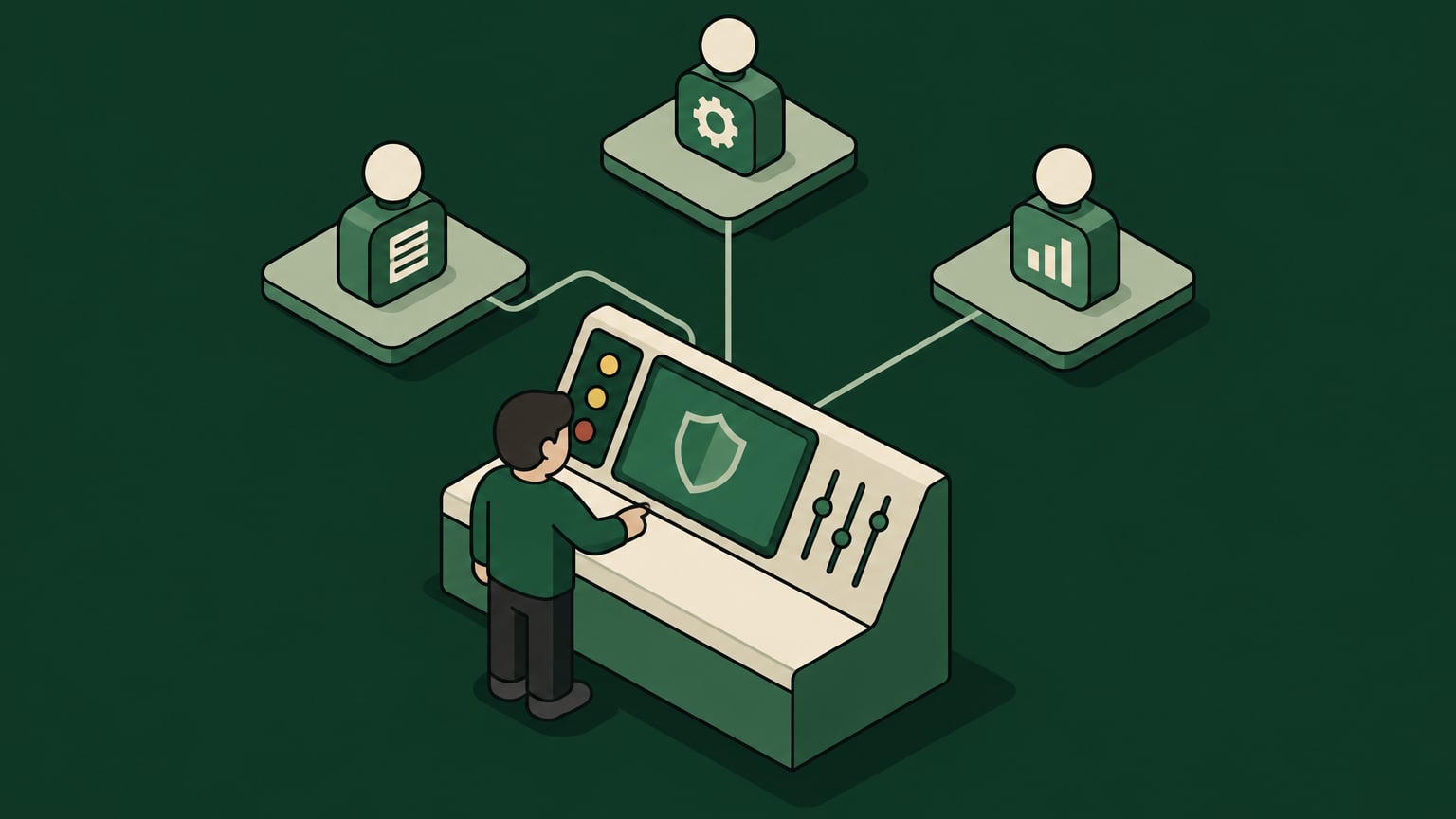
For CIOs and CISOs rolling out Claude, ChatGPT, Cursor, MCP servers, or internal agents, the question quickly moves beyond whether employees can use AI. Instead, it evolves into “What should an agent be allowed to do on an employee’s behalf inside Salesforce, Jira, Snowflake, or an internal API?”
After all, a single prompt can trigger several actions. The agent could select tools, retrieve data, pass context between systems, and may even delegate work before the employee sees the result.
So, while existing identity systems can authenticate that employee, an agentic control plane should extend governance into the agent execution that follows, connecting identity, action-level permissions, runtime guardrails, and audit records across the workflow.
Key Takeaways
- An agentic control plane governs agent actions across tools and enterprise systems.
- Runtime policy evaluates the user, agent, tool, action, data, and context before execution.
- Existing identity providers remain the source of truth for employee identity.
- Effective governance combines inline enforcement, scoped access, and tamper-evident audit records.
- Governed self-service helps teams adopt AI without turning every workflow into an IT approval ticket.
What Is an Agentic Control Plane?
An agentic control plane is a centralized infrastructure layer that governs how agents, MCP servers, tools, and enterprise systems interact at runtime.
Before an agent acts, it establishes:
- Who initiated the request?
- Which agent, skill, or machine identity is acting?
- Which tool and operation are involved?
- What data will be accessed or transferred?
- Does policy permit the action in this context?
These responsibilities extend beyond running agent logic or routing model requests.
An MCP gateway can be a central enforcement point within the broader control plane. Identity mapping, approvals, discovery, logging, and controls for other execution paths can then complete the whole system.
From Human Intent to Agent Execution
A request such as “Prepare a renewal risk summary for Acme” might lead an agent to read Salesforce opportunities, retrieve support tickets, query product usage, review legal notes, and draft an email.
Governance must therefore preserve the relationship between the employee, executing agent, backend identity, target tool, action, data, and policy decision. Shared API keys and broadly privileged service accounts can weaken that relationship by obscuring who initiated work or granting more access than the task requires.
Delegation adds yet another requirement to the list: when one agent asks another to act, the original identity and permission boundaries must remain intact.
Separating Policy from Agent Code
Shared policy should operate independently of individual agent implementations. Developers can build workflows and MCP integrations while security and platform teams define permissions across users, tools, and data classes.
For agents, that means evaluating proposed actions inline. Policy should remain consistent as teams introduce new workflows through Cursor, Lovable, Bolt, internal builders, or API-to-MCP integrations.
Why Unmanaged Agents Create Enterprise Risk
Unmanaged AI often begins with useful experimentation. Employees connect local automations, browser extensions, endpoint agents, or unapproved MCP servers to finish work faster.
As those workflows spread, three costs become apparent:
- Approval bottlenecks: IT and security repeatedly review similar tools and integrations.
- Context waste: Agents load unnecessary tools, schemas, files, and historical records.
- Weak accountability: Shared credentials make actions difficult to trace to named employees.
Scoped tool access can improve both governance and efficiency. The end goal here is a repeatable access model: employees use approved capabilities within defined boundaries, while exceptions receive appropriate review.
Where IAM and DLP Need Runtime Support
Identity and access management verifies users and manages entitlements, while data loss prevention inspects sensitive information across supported data paths. This means that both remain essential pieces of the agentic control puzzle. However, agent workflows tend to introduce additional decisions past the authentication stage, such as which tool to invoke, which records to retrieve, what to export, and where to send the result.
For example, a sales operations employee may be permitted to summarize assigned opportunities while being prohibited from exporting every customer’s contact details and renewal notes. Runtime policy can enforce that ruleset by narrowing access, redacting PII, blocking bulk exports, or requiring approval for cross-region data.
Essential Capabilities of an Agentic Control Plane
Identity Mapping and Access Control
The control plane should extend existing systems such as Okta, Entra, Active Directory, and JumpCloud. SSO establishes authentication, while lifecycle and group synchronization help keep permissions current. SCIM provides a standard for provisioning and updating identity information.
A practical identity model connects:
- The employee and relevant groups, department, role, and region.
- The agent, workflow, or skill acting for that employee.
- The machine user or service account used for execution.
- The target tool, MCP server, connector, or API.
- The permitted actions and data scope.
Action-Level Permissions and Runtime Guardrails
Access to Salesforce does not automatically justify exporting contacts, editing discounts, or updating renewal stages (authorization should distinguish between operations within the tool). Ideally, a runtime policy should evaluate the six dimensions mentioned in the table below.
Skill risk scoring can support these decisions using action type, data sensitivity, scope, and potential impact. Summarizing assigned Jira tickets, for example, carries different risks from modifying financial records or calling a production API.
Enforcement should also be able to allow or deny an operation, narrow access, request approval, filter sensitive fields, or route work through a safer tool. These boundaries also limit the consequences of prompt injection as malicious instructions in retrieved content should not expand the agent’s permissions.
Governed Tool Access and Multi-Agent Coordination
Approved MCP servers and connectors should have clear ownership, namespaces, and onboarding policies. Department-specific toolkits help users discover relevant capabilities without loading every available tool.
For multi-agent systems, event routing or message brokers can coordinate requests, policy decisions, approvals, and responses. Execution context and correlation identifiers should also travel with the work so delegation remains traceable.
Tamper-Evident Audit Trails and Observability
Audit records should capture the initiating employee, agent or skill, machine identity, tool, action, data class, policy, enforcement result, timestamp, session context, and any approval.
- Tamper-evident records support incident investigation, internal risk reviews, customer assessments, and compliance evidence.
- SIEM integration lets security teams correlate agent activity with identity events, endpoint signals, and application logs.
- Operational visibility should also cover latency, errors, blocked actions, approval delays, tool usage, and context consumption.
- Deployment reviews need to establish where prompts, tool metadata, governed data, and logs are processed, including regional and VPC requirements.
Shadow AI Discovery
Discovery should cover the environments employees actually use: Claude, ChatGPT, Cursor, Lovable, Bolt, internal builders, browser workflows, endpoint agents, local automations, and unmanaged MCP servers. A radar view should also show active tools, connected MCPs and skills, browser-based agents, departmental adoption, unmanaged workflows, and actions needing policy.
Finally, browser extensions and endpoint sensors should surface unmanaged activity. Proactive shadow MCP discovery and governance can therefore help teams identify those connections, assess their access, and bring approved workflows onto a governed path.
How Willow Can Help
Willow is the agentic access platform for enterprise AI governance, with an enterprise-grade MCP gateway as a core capability. It combines governed access and employee self-service so teams can use approved tools while security maintains policy and audit.
Additionally, Willow’s AI basecamp brings identity, scoped tool access, runtime guardrails, and audit into one platform. This lets administrators configure permissions and policies centrally, while employees access approved capabilities through a self-service portal.
Willow brings together:
- Identity mapping: Employees, groups, agents, machine users, and tools connect to existing IdP context.
- MCP governance: Approved MCPs and tools sit behind governed access.
- Action-level permissions: Users and agents receive rights appropriate to the operation.
- Runtime guardrails: Inline policies govern tool calls, with PII and response redaction before sensitive information reaches model context or the client.
- Radar visibility: Teams discover shadow AI, unmanaged agents, MCPs, and browser activity.
- Audit trails: Records connect the human identity, agent, tool, action, policy decision, and result.
How Agent Governance Looks Like With Willow
Innovid uses Willow to govern and secure developers’ local machines, including exposure to MCP servers and external skills. Assaf Grimberg, SVP Software Engineering, has credited the platform with improving access control and reducing risk.
How a Governed Tool Call Typically Works
Consider a customer success leader requesting a renewal brief using Salesforce opportunities, Jira support tickets, and Snowflake product usage.
- The employee asks the agent to prepare the brief.
- The platform establishes the employee’s IdP attributes, agent identity, and applicable scope.
- The agent proposes a tool call through an MCP server, connector, or governed API.
- Controls check the operation, arguments, data, user permissions, context, and approval status.
- An assigned-account lookup proceeds. A prohibited bulk export is then either blocked or marked as pending approval.
- The tool receives the permitted request, and response controls remove restricted information.
- Audit logs retain the identities, action, policy outcome, and timestamp, with export to security systems where required.
- The employee receives the brief produced through the governed workflow.
With this flow in place, each subsequent action receives its own evaluation. At the same time, permission to retrieve a record does not automatically authorize updating it or transferring it elsewhere.
Model Routing vs. Agent Governance
Model gateways help applications select providers, route requests, and manage usage. At the same time, agent governance typically addresses operations inside enterprise tools.
When evaluating platforms, it helps to distinguish model routing from controls over tool access, actions, and data. Because of this, we recommend that you compare AI gateways and governance platforms to spot those differences and evaluate how critical they are to your business.
Implementing Governed AI Access
An internal implementation can combine MCP integrations, identity services, approval workflows, policy engines, and SIEM logging. Building and maintaining these capabilities requires dedicated engineering capacity, ongoing integration work, and ownership of policy enforcement as tools and workflows change.
With that said, whether building or adopting a platform, a rollout should follow a defined process:
- Map current usage. Inventory approved and unmanaged agents, tools, credentials, owners, and execution paths.
- Connect enterprise identity. Apply existing groups, lifecycle controls, and machine-user ownership.
- Define department toolkits. Expose approved capabilities relevant to each team.
- Set operation-level policies. Separate routine reads from exports, writes, deletes, and production changes.
- Apply runtime controls. Establish authorization, redaction, approvals, and handling for policy-service failures.
- Test boundaries. Verify legitimate workflows and attempts involving excessive scope, revoked access, manipulated arguments, and prompt injection.
- Measure and expand. Track completed workflows, adoption, blocked actions, latency, errors, and approval time.
Governing Enterprise AI at Runtime
Simply put, an agentic control plane connects the employee’s request to the permissions governing every subsequent action. Its essential functions are identity mapping, scoped access, inline authorization, sensitive-data controls, and reviewable audit records. Together, they give enterprises a consistent way to operate agents across shared business systems.
As adoption expands, the internal agenda becomes whether the organization can establish who acted, through which agent, against which tool and data, under which policy. A control plane makes those boundaries enforceable while giving teams a repeatable path from experimentation to production.
Willow’s agentic access platform connects enterprise identity, governed MCP access, action-level permissions, runtime guardrails, and audit across agent workflows. Start free with Willow to explore governed agent access, and review enterprise plans for identity integration, action-level permissions, and runtime guardrails.
Frequently Asked Questions
What should happen if the policy service is unavailable?
You would need to define failure behavior before deployment, deny or pause protected operations when the system cannot establish authorization, and record the failure for investigation.
Can a control plane undo an agent’s completed action?
The target system determines whether you can reverse a completed action. Make sure to always require approval for high-impact operations and define recovery procedures before granting agents write access.
How should policies change when a tool is updated?
We recommend reviewing the changes to tool schemas, arguments, and backend permissions before approving the new version. Additionally, make sure to test existing policies against the updated tool – especially when it adds operations or expands data access.
Background Agents in the Enterprise
Most teams can spin up an agent. Few can deploy one their security team signs off on. Here's the framework that does both.
FAQS
Everything you need to get your Basecamp running.



Your agents are already in the wild.
Give them a Basecamp. Go from AI chaos to AI work, in minutes.
