


AI Governance Platform vs AI Security Platform: Key Differences Explained

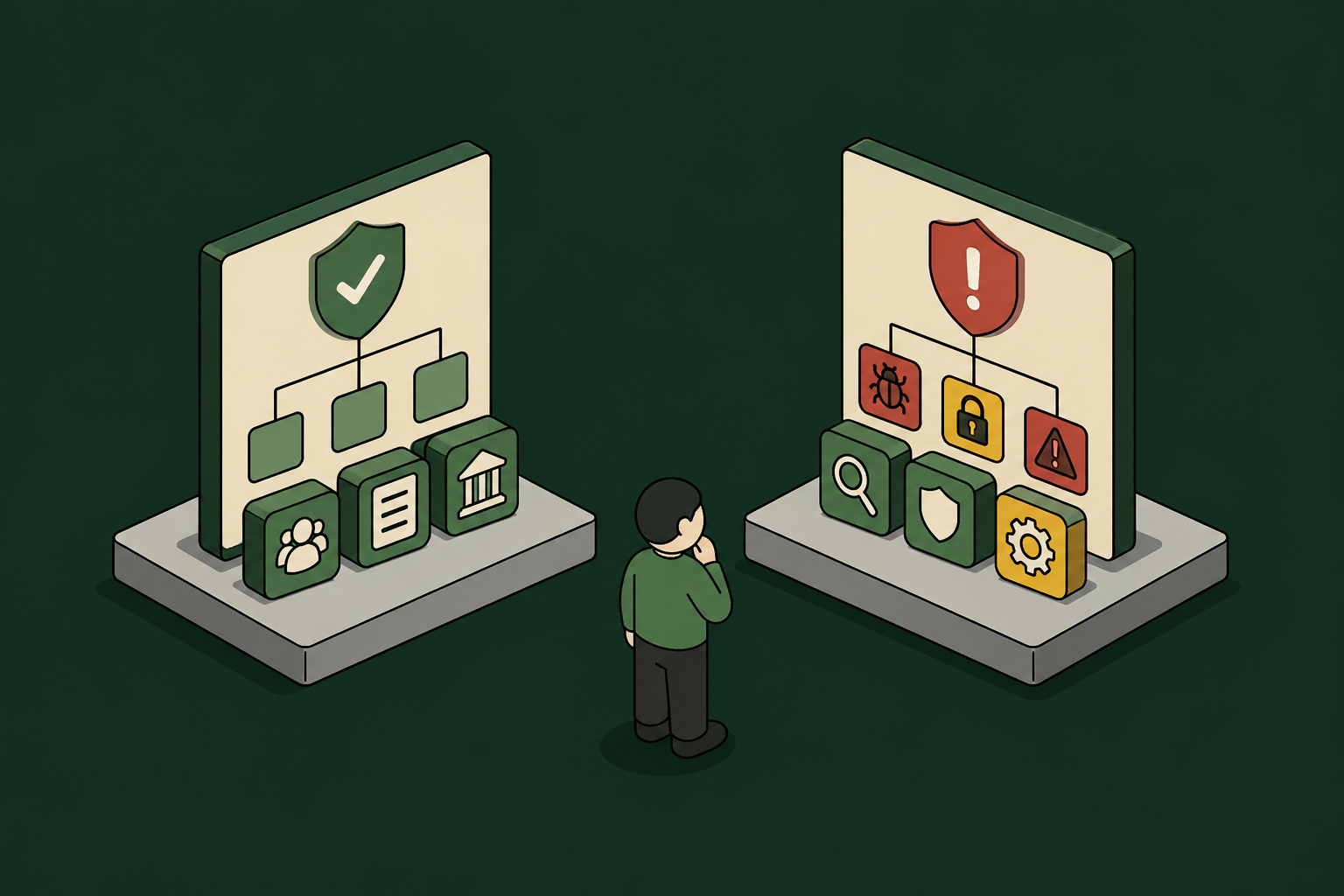
Most enterprise buyers enter the market for AI governance tools and leave with the wrong category.
They either buy a policy documentation platform when what they need is runtime control, or a security scanner when what they need is a compliance framework. Neither vendor is misleading them.
The two categories look similar from the outside and often use overlapping language.
The difference is what each one governs.
A company that buys governance when it needs security has a clean compliance record but is at risk of a breach. A company that buys security when it needs governance has a well-defended model layer but may not pass an EU AI Act audit.
Governance platforms manage documentation, classification, and compliance. They inventory your AI systems, classify their risk levels, map controls to regulatory frameworks, and generate evidence packages for auditors.
Security platforms protect against threats. They detect prompt injection attacks, block data leakage, monitor model behavior in real time, and surface anomalies before they become incidents.
The market is large enough to obscure this boundary. Estimates vary by how the category is defined. Forrester Research projected off-the-shelf AI governance software spending to reach $15.8 billion by 2030, while Gartner's 2026 estimate puts spending on dedicated AI governance platforms at $492 million for the year. The two figures measure different slices of the market over different timelines.
TL;DR: Buyers reach for two product categories to govern AI, but neither controls what an agent does inside a tool. A third layer supplies that control.
- AI governance platforms document and prove compliance for auditors.
- AI security platforms block model-layer threats such as prompt injection.
- The identity and access layer scopes each agent action to a real employee and produces the runtime audit trail the other two cannot.
Match your first purchase to whichever gap is most urgent right now.
AI Governance vs. AI Security: Why the Confusion Costs You
Both governance and security platforms involve policies, monitoring, and guardrails. But they serve different audiences, enforce at different moments, and the questions they answer barely overlap.
Governance asks whether an AI system is documented, risk-classified, and compliant with your regulatory frameworks. Security asks whether a given AI request is safe from adversarial inputs and data leakage.
On the security side, the threat is real and rising. AI-enabled adversary attacks increased 89% year over year (CrowdStrike Global Threat Report, 2026). Attacks that began with the exploitation of public-facing applications rose 44%, driven by missing authentication controls and AI-enabled vulnerability discovery (IBM X-Force Threat Intelligence Index, 2026).
On the governance side, Gartner predicts that over 40% of agentic AI projects will be canceled by the end of 2027, driven in part by inadequate risk controls (Gartner, June 2025). Buy only a security platform, and you risk an audit you cannot pass.
But there is a third problem that neither a pure-play governance platform nor a strictly security platform will solve.
What neither governance nor security covers is what a specific agent did inside Salesforce at 2 AM, under whose identity, and whether it was authorized. For that, you need an AI identity and access platform.
An AI agent is software that uses a large language model to act on your behalf. It calls tools, reads data, and changes records rather than answering questions. The action it takes needs to be governed just as much as the request it receives.
That action-layer question is the one most programs leave unanswered.
Willow is neither an AI governance platform nor an AI security platform. It is the Agentic Access Platform, the identity and access layer beneath both. Governance documents what an agent is allowed to do, security screens what goes in and out, and the access layer binds each agent action to a real employee identity and enforces it at runtime.
Willow fills this third gap by routing every agent through one enforced flow. (1) The agent connects only to approved apps, (2) Willow verifies the real employee identity behind the agent through your existing IdP (Okta, Entra ID, or JumpCloud), (3) it then checks what that person is permitted to do inside the specific tool, executes the action, and logs everything the agent does inside the app.
Because each agent inherits a real employee's identity instead of an anonymous service account, every action it takes carries an owner, permissions can be defined and enforced, and an auditor can trace it all.
What AI Governance Platforms Actually Do (and Don't Do)
AI governance platforms give you a defensible record of every AI system you run. Their job is to satisfy regulators and auditors, so what they produce is documentation and evidence an audit can stand on.
(1) Policy documentation helps you write, version, and approve AI usage policies across teams and use cases. They maintain a record of what was decided, when, and by whom.
(2) Model inventory registers AI systems, and tracks versions, owners, deployment dates, and risk classifications.
(3) Risk assessments score models against the regulatory frameworks that matter to your business. For example, the EU AI Act is the European regulation that sorts AI systems into risk categories, the NIST AI Risk Management Framework (NIST AI RMF) which is the US voluntary standard for AI risk management, and ISO 42001 is the international AI management system standard.
(4) Compliance mapping links existing controls to framework requirements and generates evidence packages for external audits.
(5) Bias and fairness monitoring flags model outputs for demographic bias and fairness metric violations. Important for regulated industries where algorithmic decisions affect people directly.
Governance tools cover the model and the use case, but still sit one level above the individual action an agent takes inside a live tool.
A policy document that says "this agent may only read CRM records, not modify them" does not prevent a deployed agent from modifying CRM records. It documents the intent, and any violations it catches after the fact.
Enforcement is a separate technical layer that governance platforms were not designed to provide. By the time a governance audit finds an unauthorized action, the action has already happened. Often, because the platform does not log individual tool calls or tie back to employee identities, the evidence trail also lacks the granularity needed to reconstruct what occurred.
What AI Security Platforms Actually Do (and Don't Do)
AI security platforms protect against threats at the model and network layer. They operate in front of or alongside your AI systems, monitoring and filtering what goes in and what comes out.
Security confirms the request was clean. Whether the agent was authorized to touch that data, and who signed off, sits in the identity layer it never sees (or in some organizations, does not exist).
Their strength is at the model boundary, where they inspect every request and response for known attacks and leaks.
(1) Prompt injection protection detects and blocks adversarial instructions embedded in user prompts or in external content that an agent retrieves and processes.
The malicious instructions that prompt injections protect against are designed to override the model's intended behavior and redirect it toward attacker-controlled goals.
It is the OWASP number one risk for LLM applications.
In agentic systems, indirect injection is particularly dangerous because an agent that reads a poisoned document or email can be redirected at machine speed before any human notices.
(2) Data loss prevention (DLP) involves scanning agent inputs and outputs for personally identifiable information (PII, information that identifies or could identify a specific person), credentials, and regulated content before it is exposed.
AI tools can route sensitive data to external model APIs during normal operation. Either in error, or because a user query or agent instruction did not account for the fact that PII could potentially enter the context, and there was no action-level or access-level protection against it.
80% of U.S. CISOs report concern about customer data loss via public GenAI platforms (Proofpoint Voice of the CISO, 2025). The concern is legitimate and the security controls that address it are necessary.
But addressing it entirely at the model layer, without identity binding and action-level scoping, leaves the question of authorization unanswered. Even if the data transfer was threat-free, was the agent supposed to have access to that data at all? Only proper identity binding and action-level permissions can answer that.
(3) Model firewalls filter model inputs and outputs against known threat signatures, content policies, and behavioral anomalies. All this happens at the request layer, before and after the moment a model processes a prompt and generates a response.
It operates at the boundary between the user/agent and the model. But it stops short of the tool calls that the model subsequently makes.
(4) Shadow AI discovery surfaces AI tools and models in use across the organization. This includes, importantly, tools deployed without IT or security approval. The option you then have is to block them or bring them into your governance layer and register.
99% of organizations already have sensitive data exposed to AI tools (Varonis State of Data Security, 2025). Shadow AI discovery is how you find AI use that is not currently governed or controlled, and needs to be.
Security endpoints do have their limitations, though.
A model firewall can block a prompt injection attack at the inference layer. It cannot tell you whether the agent that called your Snowflake endpoint afterward had permission to export that specific dataset. Neither can it attribute that export to a specific employee where the organization's identity provider, and associated permissions, would have governed the scope of that access.
Governance vs. Security vs. Identity and Access: A Capability Matrix
Three controls answer different questions and enforce at different moments. Governance proves a system was reviewed, security screens each request, and an identity and access layer binds each action to a named employee and enforces permissions at runtime.
The identity and access layer makes it possible to scale AI deployment, by using built in already approved permissions tied to existing identities. It also makes it possible to quickly decommission agents when an employee leaves, or adjust permissions when someone changes roles.
The Three Layers of AI Agent Control: Connection, Action, and Context
Most AI security and governance programs govern the wrong layer. They focus on the connection layer by blocking or allowing tool access at the API boundary.
The connection is layer one of three, and the least granular once agents are in production and calling real tools with real data.
Layer 1: Connection (which tools an agent can reach)
This is governed by MCP gateways and API firewalls.
MCP (Model Context Protocol) is the open standard that defines how AI agents connect to tools and data.
Anthropic originally developed the protocol, and most major agent frameworks now support it.
Most AI gateways stop at the connection layer.
The practical implication of that is that an agent approved to "use Jira" can read every ticket across all projects, create new ones, delete existing ones, reassign issues, and access the audit history. Because all of those actions sit inside the granted Jira connection.
The gateway sees "agent connected to Jira" and records the event. It does not see or govern what happens next and which actions can be taken.
Layer 2: Action (what the agent can do inside each tool, and under whose identity)
The action layer goes a step beyond approving connections, and handles fine-grained action-level permissions within approved apps.
The action layer is what decides whether an agent can drop a database or table, or only read from it.
Layer 3: Context (which data the agent can access, under what conditions)
An agent with Salesforce read access at the action layer can still be scoped at the context layer to read only the records within a specific account owner's portfolio, or to require human approval (surfaced in Slack, the Willow for Chrome extension, or in-app) before accessing records flagged as sensitive.
Layer one is where most platforms stop. Willow handles all three (Platform Overview). It blocks apps agents aren’t permissioned to access, and actions it’s not allowed to take. When more granular restrictions are needed, it enforces contextual limitations, such as restricting an agent to the records tied to a specific account owner, or requiring human approval before it can reach data flagged as sensitive.
Why Identity Is the Missing Link Between Governance and Security
An AI agent acting under an anonymous API key is structurally ungovernable. You can document that it exists (governance). You can monitor its outputs for threats (security). But you cannot say which employee authorized its actions, whether that employee still works at the company, whether the scope it was granted when it was provisioned still matches the employee's current role, or who to hold accountable when something goes wrong.
Non-human identities already outnumber humans about 45:1 on average, and up to 144:1 in cloud-native environments.
Only 28% of organizations can reliably trace agent actions to a human or system across all environments (Cloud Security Alliance / Strata Identity, February 2026). More than half (51%) report no clear ownership of their AI identities (Cloud Security Alliance, May 2026).
Eight percent of enterprise non-human identities lose their HR-ownership link the moment the person who created them leaves (Entro Security, May 2026). Identity is what makes governance policy enforceable and security audit trails meaningful. It also makes both scaling AI agent use, and decommissioning it, possible.
97% of organizations that suffered an AI-related breach lacked proper AI access controls (IBM Security / Ponemon Institute, 2025).
Governance binds to a real person
A policy that says "this agent may read contracts but not sign them" becomes enforceable when the agent acts under an employee identity. If the employee's role changes from "contractor" to "senior counsel," the agent's permissions update automatically.
The policy follows the person, so when their role changes the agent's permissions change with it.
Security audit trails trace to an accountable principal
"Which agent called the Snowflake export endpoint at 11:47 PM on Thursday" becomes answerable: the agent running under the identity of a specific employee, with read-only permission on the data warehouse, using a scoped credential that expired after the task completed. That level of attribution is what a regulator or forensic investigator needs. A session log that records "service-account-27 connected to Snowflake" does not give them that.
Deprovisioning is automatic and complete
When the employee offboards, the agent loses access immediately through SCIM deprovisioning. No orphaned API key continues operating with production Salesforce access six months after the analyst who created it left the company.
This addresses one of the most common agentic security gaps: the NHI sprawl problem. NHI, or non-human identity, covers service accounts, API keys, OAuth tokens, machine certificates, and agent credentials, and their numbers dwarf the human kind (Cloud Security Alliance, 2026).
At Wix, Willow governs roughly 5,000 weekly active users, around 600 governed tools and MCPs, and 300,000+ governed tool calls every week (Wix case study). "We are six to ten months ahead of most companies in AI adoption. More code to production, fewer incidents, real outcomes." (Asaf Yonay, Head of AI Core, Wix).
Scaling AI agent use is no longer messy when identity is pre-wired. Agents inherit existing Okta groups and roles, so each action already carries the employee identity an auditor asks for. No retrofitting permissions or building out new permissions groups for different agents. It’s all built in from day one.
Where to Start: Match the Platform to Your Gap
Where you start depends on which gap is most urgent for you right now. Most enterprises fall into one of three situations. Agents may already be running in production, a compliance deadline may be approaching with no system inventory in place, or both may be true at once. Each one points to a different first move.
If your AI agents are already in production and your primary risk is ungoverned runtime behavior (agents calling production tools with no action-level scoping, no identity binding, no per-action audit trail), then start with an identity and access layer to bind every agent to a real employee identity and scope permissions at the action level. Add a model governance platform for regulatory compliance documentation in parallel.
If your primary gap is compliance documentation and you have a regulatory deadline approaching with no AI system inventory, then start with a governance platform (OneTrust, IBM watsonx.governance, Credo AI) to build the inventory and compliance trail. Then add an action-layer identity platform once agents move into production.
If you are in a regulated industry with both an audit deadline and live agents already calling production systems: you need both running in parallel. The governance platform covers regulatory documentation and compliance evidence. The identity and access layer covers runtime accountability and per-action audit. Neither substitutes for the other.
The pattern across all three scenarios is the same: start where your live risk is, then close the adjacent gap. The longer you wait on either side, the wider the distance between your documented policy and your deployed reality.
Willow: The Identity and Access Layer for AI Agents
Willow is the Agentic Access Platform, the identity and access layer for AI agents at work. It covers all three layers of control, connection through action to context, so the platform that lets an agent reach a tool also governs what it does inside and pulls that access when the person behind it leaves (Platform Overview). Every agent inherits a real employee's identity through your existing IdP (Okta, Entra ID, or JumpCloud) with SCIM provisioning, so when someone changes role or offboards, the agent's access updates or revokes automatically.
Permissions are app-aware and scoped to the action level inside each tool.
Willow provides a governed marketplace of 1,000+ integrations (100+ pre-built connectors), 50+ skills, and 10+ plugins.
Any internal API can be wrapped as a governed MCP tool without backend changes, and employees self-serve from the approved catalog in the Toolshed instead of filing tickets, while admins set the rules in the Permit Office.
Native shadow-AI discovery surfaces what you never routed: unmanaged agents, rogue MCP servers, personal API keys, and unapproved skills and plugins, found through a Chrome extension and endpoint sensors before they reach production. As Willow frames it, shadow AI is already in the org; the question is whether anyone can see it.
Every call, tool, prompt, and identity lands in one audit trail, exportable to Splunk, Loki, and Grafana for any compliance framework, and one click revokes any agent or tool across the org the moment something looks wrong.
Deployment options span SaaS, self-hosted (AWS, GCP, Azure), and on-prem/air-gapped, with full feature parity across all three. Pricing starts at Free ($0 for up to 5 users), runs through Startup ($15 per seat), and reaches Enterprise (custom), with details at withwillow.ai/pricing.
Willow is SOC 2 Type II certified. Compliance reporting is pre-built for SOC 2, GDPR, HIPAA, and ISO 27001 (Governance and Compliance).
For organizations that have made the call to ship AI agents broadly, the governance question becomes which layer to govern. Connection governance confirms an agent reached a tool. The control a security lead is accountable for is the next layer down (what the agent did inside the tool, whose authority backed the call, and whether that is provable to an auditor). Governance documentation and model-layer security do not provide that without the identity layer in between.
Further Reading
- Willow Identity and Access Platform: https://withwillow.ai/platform/identity-access
- Willow Governance and Compliance: https://withwillow.ai/platform/governance-compliance
- Willow Wix case study: https://withwillow.ai/blog/wix-case-study
- EU AI Act plain-language summary (artificialintelligenceact.eu): https://artificialintelligenceact.eu
- NIST AI Risk Management Framework resource hub: https://airc.nist.gov
- CrowdStrike 2026 Global Threat Report: https://www.crowdstrike.com/global-threat-report/
- IBM X-Force Threat Intelligence Index 2026: https://www.ibm.com/reports/threat-intelligence
- IBM Cost of a Data Breach Report 2025: https://www.ibm.com/reports/data-breach
- Cloud Security Alliance, Non-Human Identity Governance Vacuum, 2026: https://labs.cloudsecurityalliance.org/research/csa-whitepaper-nonhuman-identity-agentic-ai-governance-v1-cs/
- Varonis 2025 State of Data Security Report: https://www.varonis.com/blog/state-of-data-security-report
- Proofpoint Voice of the CISO 2025: https://www.proofpoint.com/us/voice-of-the-ciso
- Gartner: 40% of enterprise apps will feature task-specific AI agents by 2026: https://www.gartner.com/en/newsroom/press-releases/2025-08-26-gartner-predicts-40-percent-of-enterprise-apps-will-feature-task-specific-ai-agents-by-2026-up-from-less-than-5-percent-in-2025
Background Agents in the Enterprise
Most teams can spin up an agent. Few can deploy one their security team signs off on. Here's the framework that does both.
FAQS
AI governance platforms manage policy, compliance, and risk documentation across your AI systems. They answer the regulatory question: what AI do you have, who owns it, how did you classify its risk, and what evidence do you have that you followed a review process?
AI security platforms protect against runtime threats: prompt injection attacks, data leakage, adversarial model manipulation, and shadow AI exposure. Governance works at the organization and model level, mostly before and after deployment.
Security lives at the request and inference layer, active during each model call. Both are necessary, and neither substitutes for the other.
Most organizations with AI agents in production need both, but the priority depends on your current gap. If you have a regulatory deadline and no inventory of your AI systems, governance documentation is the first priority.
If your agents are already calling production tools with no runtime controls, security and identity controls are the first priority. A useful diagnostic is whether you can answer two questions today.
The first is a governance question. What AI systems do you have, and who is responsible for each?
If you cannot answer that, you have a governance gap. The second is an identity and access question.
What did this specific agent do inside Salesforce last Tuesday, under whose identity? If you cannot answer that, you have an identity and access gap.
In most organizations, AI governance sits under the Chief Risk Officer, General Counsel, or a dedicated AI governance function reporting to the CRO or CISO. AI security typically reports directly to the CISO.
The operational challenge is that both functions govern the same agent deployments: governance sets the policy, security enforces threats at the model layer, and neither team owns the tool that governs what the agent does at the action layer. An identity and access layer with a shared audit trail bridges that gap, because both functions can query the same per-action log.
The most common mistake is treating compliance documentation as equivalent to runtime control. Organizations buy a governance platform, document their AI systems, complete a risk classification, and assume they have governed their agents.
The documentation does not prevent an agent from taking an unauthorized action in a live tool. The second common mistake is treating connection-layer security, including API firewalls and MCP gateways, as full governance.
Knowing an agent reached Salesforce is not the same as knowing what it did there. AI agent control lives at the action layer, and most organizations do not have a tool governing that layer.
The EU AI Act is the European Union's risk-based framework for regulating AI systems deployed in Europe. It categorizes AI systems by risk level (unacceptable, high, limited, minimal) and assigns compliance obligations accordingly.
Article 50 transparency obligations take effect on August 2, 2026. High-risk systems under Annex III face a compliance deadline of December 2, 2027.
Penalties reach up to 35 million euros or 7% of global annual turnover (EU AI Act, European Commission). For most enterprises, the practical requirement is an inventory of AI systems, a risk classification for each, evidence of a review process, and documentation that usage policies are in place.
An AI governance platform provides the documentation infrastructure. An identity and access layer provides the runtime audit trail that shows the policies were enforced in production.
Everything you need to get your Basecamp running.

Your agents are already in the wild.
Give them a Basecamp. Go from AI chaos to AI work, in minutes.
