


Human in the Loop AI: From Manual Approval to Runtime Enforcement

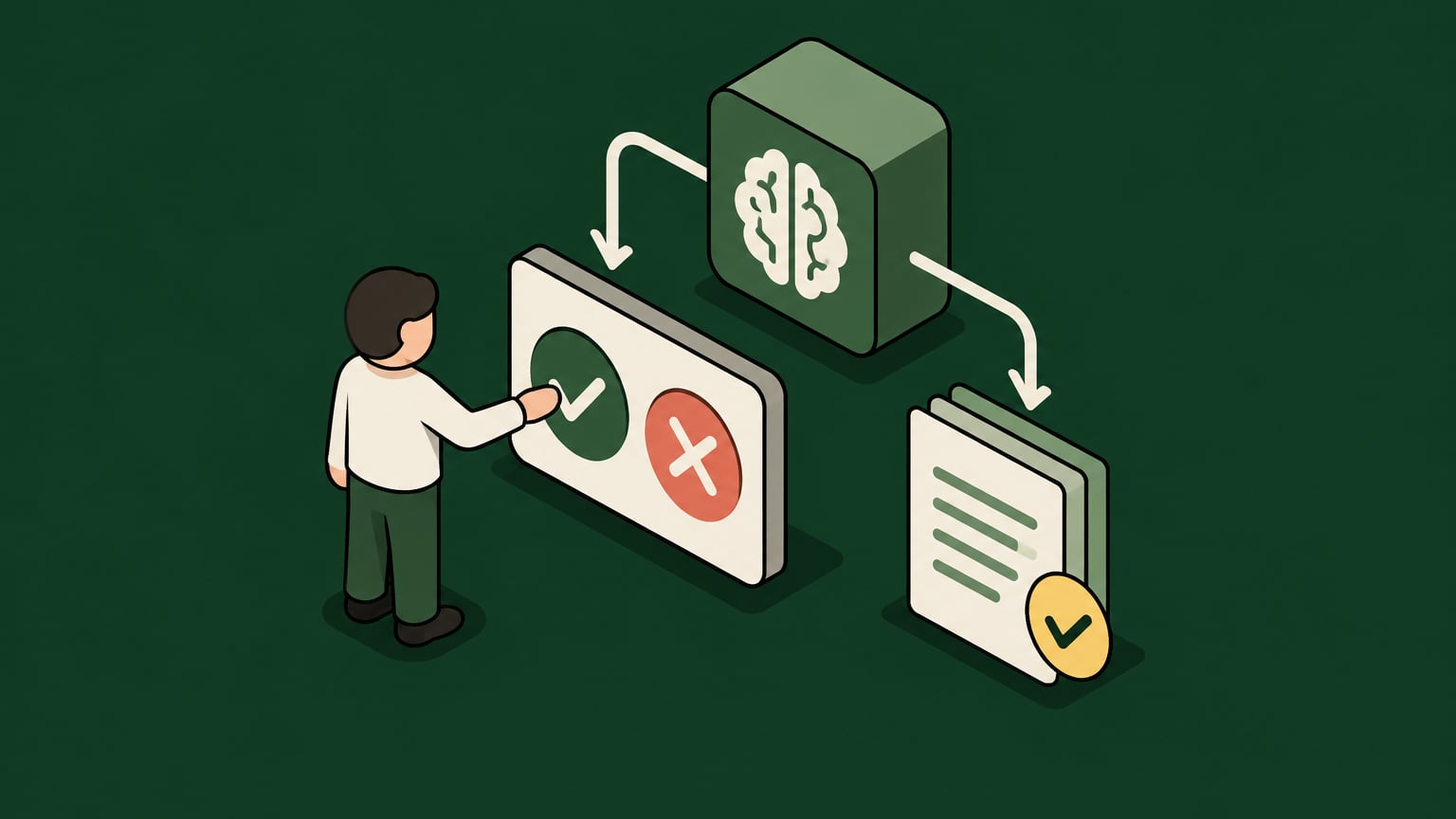
Human in the loop AI means a human remains accountable for how an AI system learns, decides, or acts. In enterprise agentic AI, however, that accountability can’t depend on someone clicking approve for every action. The durable version is human approval enforced at runtime, where humans define policy, access scope, and escalation rules once, then systems enforce them on every agent action.
That shift is necessary because autonomous agents call tools, query systems, open tickets, write code, update records, and interact with enterprise data. Manual review still has a place in model training and quality assurance, but it breaks down when AI agents operate across Jira, GitHub, Slack, Salesforce, internal databases, and MCP servers at machine speed.
Key Takeaways
- Human-in-the-loop AI works well for model training, data annotation, quality assurance, and edge-case review, but those workflows don’t scale cleanly to autonomous agent actions.
- Agentic AI needs structural oversight, where approved policies enforce identity, scope, least privilege, and escalation rules during tool use.
- Manual approval workflows create bottlenecks when agents generate high volumes of tool calls, workflows, and vibe-coded apps across departments.
- AI governance requires more than visibility. Accountability depends on knowing which agent acted, under which policy, against which system, and with which permitted action.
- Willow provides an enterprise MCP gateway as a way to easily enforce scoped access and runtime guardrails across agent tool use.
Defining Human in the Loop AI for the Enterprise
For enterprise governance, human-in-the-loop (HITL) defines where human judgment enters the AI operating model, including training review, policy approval, exception handling, and runtime constraints.
Human-in-the-loop systems and HITL AI both describe the same governance principle: people provide judgment where automation lacks enough context, certainty, or authority to act alone. In the enterprise, that principle applies to model improvement, workflow review, policy enforcement, and agentic access control.
That pattern supports a continuous feedback loop, since human judgment improves model accuracy, reduces bias, and catches edge cases that automation handles poorly.
For enterprise teams, human in the loop AI has 4 main jobs:
- Improve model quality: Humans label examples, review false positives, correct hallucinations, and feed better examples back into training or evaluation.
- Control business risk: Reviewers approve decisions that affect customers, employees, regulated data, or production systems.
- Create accountability: Human oversight gives the organization a record of who approved, corrected, escalated, or rejected a system action.
- Translate policy into operation: Governance teams define acceptable use, data boundaries, escalation rules, and approval requirements.
Note: A classifier that flags invoices for review can tolerate manual checks, but an autonomous agent that creates Jira tickets, edits code, and calls internal APIs needs policy enforced during execution, rather than only after a human reviews a summary.
The Traditional Feedback Cycle and Its Limits
The traditional HITL cycle comes from supervised learning, active learning, data annotation, and quality assurance. A model produces an output, a human reviews it, the system records feedback, and that feedback improves the next training or evaluation cycle.
That model works well in cases such as:
- Data annotation: Humans label text, images, audio, or transactions so a model can learn from higher-quality examples.
- Model training: Reviewers correct predictions, evaluate edge cases, and improve predictive accuracy over time.
- Manual review: A person approves or rejects model outputs before the organization acts on them.
- Quality assurance: Teams sample outputs to detect drift, bias, hallucinations, or unacceptable behavior.
With that said, there’s a clear trade-off – while human review improves trust and accuracy, it also adds latency. Traditional HITL also assumes the workflow is known in advance. For example, a claims process, contract review queue, or invoice approval chain all have defined steps.
However, Agentic AI is different because employees can create new workflows, connect new MCP servers, or generate vibe-coded apps outside the original process design.
Why Traditional HITL Breaks Down with Autonomous Agents
Agentic AI worsens the oversight problem because autonomous agents operate through delegated access. They use credentials, call APIs, read and write data, and trigger workflows across systems that already have business authority.
Shadow AI makes this even harder. New agents, unmanaged MCP servers, local developer tools, browser extensions, and vibe-coded apps can all appear faster than a central team can manually review them.
The Speed and Scale Problem
Manual approval workflows collapse when every agent action needs human review. A human can review a high-risk deployment request, a privilege escalation, or a production data export. The same human, however, can’t review every read, write, search, ticket update, and repository action across high volumes of tool calls without slowing adoption.
Approval also needs context. A generic “approve” button doesn’t prove the reviewer understood the target system, environment, operation, data sensitivity, and downstream impact. An approval for a Jira ticket read in a sandbox project isn’t equivalent to an approval for deleting production incidents or reassigning customer escalation tickets.
Autonomous agents multiply that context problem because they chain actions. One step may look harmless, but the sequence can create risk, for example:
- Read customer records from a CRM.
- Summarize the records in an external tool.
- Create a ticket with sensitive details.
- Notify a public channel.
- Trigger a follow-up workflow through another connector.
Vibe-coded apps create a second scaling issue. When employees generate internal tools quickly, those apps may connect to SaaS systems, internal APIs, or local MCP configurations before IT has reviewed ownership, data scope, retention, or audit requirements.
The Solution: Human Approval Enforced at Runtime
The mature enterprise model for human in the loop AI is human approval enforced at runtime.
In plain terms, that means humans still define the rules. This way, security, IT, legal, data owners, and application owners still get to decide which agents can use which tools, what actions they can perform, which data they can access, and which actions require escalation. The difference is that those decisions become enforceable policy instead of ticket comments or external governance documents.
Identity and Context-Aware Permissions
Agentic access starts with identity because anonymous automation can’t be governed well. With this in mind, good agent authorization needs 4 layers of context:
- Actor: Which human, team, machine user, or agent initiated the request.
- Tool: Which MCP server, SaaS connector, API, repository, or internal system the agent is calling.
- Action: Whether the request reads, creates, updates, reassigns, deletes, exports, or triggers another workflow.
- Resource and environment: Which project, repo, customer record, production system, or sandbox the action targets.
Note: Least privilege becomes practical only when policy reaches this action and resource layer. A short-lived credential reduces exposure duration, but it can still authorize an immediate destructive operation if the action scope is too broad. Scoped access, on the other hand, limits what the agent can do while the credential is valid.
Real-Time Guardrails and Auditing
Runtime guardrails evaluate agent actions while the agent works. That’s different from traditional model training, where human feedback improves future model behavior. But while training feedback helps the model produce better outputs later, runtime guardrails alone decide whether a specific action should execute now.
For agentic AI, runtime enforcement should evaluate the requested tool, action, data class, environment, and policy impact before the call proceeds. Following this logic, a read against a low-sensitivity knowledge base deserves different treatment from a delete action against production infrastructure or an export from a customer system.
Additionally, prompt injection protection also belongs at runtime because malicious instructions can arrive through connected tools, documents, tickets, repositories, or external skills. A fallback mechanism should define what happens when policy can’t safely allow the request, such as blocking the action, escalating for review, reducing the permitted scope, or requiring the agent to retry through an approved tool path.
Audit trails need the same level of precision. A useful record should show:
- Which identity initiated the action.
- Which agent or machine user executed it.
- Which tool and resource were targeted.
- Which policy allowed, blocked, or escalated the action.
- Which approval, if any, applied to the reviewed request.
- Which logs streamed into systems such as a Security Information and Event Management platform.
How Willow Can Help
Willow offers a ready-made enterprise MCP gateway solution for enforcing a policy on tool calls that pass through it. With Willow, your agents also get assigned identity, permitted actions, and audit requirements before connecting to tools.
A human then defines the policy once, and runtime enforcement applies it every time the agent attempts a tool call. This way, you can quickly turn human judgment from a repetitive approval queue into enforceable policy, access control, scope, exception handling, and audit review.
Achieving Safe AI Adoption at Scale
Safe AI adoption at scale depends on replacing ad hoc review with an operating model that lets employees use approved agents and tools without waiting on every request. That model needs to serve the board’s adoption mandate and the security team’s accountability requirements at the same time.
Your enterprise AI policy should therefore define where agents can operate, which systems they can touch, and which actions require escalation. The next decision is where to place human judgment: inside every workflow as manual approval, or upstream as policy that runtime controls can enforce.
That upstream model is exactly what Willow is built to run on. Start free with Willow today to connect your first agents and tools. And when your rollout starts bleeding existing IdP groups, scoped action permissions, runtime guardrails, and enterprise audit streaming, compare Willow's enterprise plans.
Frequently Asked Questions
Which agent actions should still require human approval?
High-impact agent actions should still require human approval when policy alone can’t capture the business impact. Examples include production changes, broad permission grants, sensitive data exports, and destructive operations against customer or infrastructure records.
However, the approval should review the actual target, environment, operation, and impact. If the agent changes the request or execution plan, the approval should be reviewed again before the action proceeds.
How should enterprises govern local MCP configurations?
Start by discovering which MCP servers and local agent configurations exist on developer machines and endpoints. Next, assign ownership, evaluate the connected tools, remove local secrets where possible, and route approved access through governed paths.
Does Willow replace Okta or Entra?
No. Willow plugs into and extends the identity stack an enterprise already uses, including Okta, Entra, Active Directory, and JumpCloud. Existing IdP groups can support agent RBAC through SCIM, while Willow governs what agents are allowed to do inside connected tools.
Human accountability vs. approval in HITL AI: what’s the difference?
Human accountability means the enterprise can identify who authorized the policy, which agent acted, and which rule allowed or blocked the action. Human approval is narrower because it usually refers to a person reviewing a single request before execution.
For agentic AI, accountability requires traceable identity, scoped permissions, and audit records even when no one manually approves a low-risk action.
How is runtime HITL different from IAM or DLP?
Runtime HITL governs the agent’s action at the moment it tries to use a tool. IAM authenticates identities and manages access, while DLP focuses on sensitive data movement, but agentic AI also needs action-level decisions tied to context.
For example, a user may have access to Salesforce, but an agent acting for that user shouldn’t automatically inherit permission to export customer records or write them into another system.
How should an enterprise prove that HITL governance supports AI adoption?
By measuring safe usage instead of just blocked activity. Useful evidence includes which teams use agents, which tools agents call, which workflows move through approved paths, and where manual tickets decrease. Security teams should also track audit completeness, policy exceptions, and escalations.
Background Agents in the Enterprise
Most teams can spin up an agent. Few can deploy one their security team signs off on. Here's the framework that does both.
FAQS
Everything you need to get your Basecamp running.


Your agents are already in the wild.
Give them a Basecamp. Go from AI chaos to AI work, in minutes.
