


Shadow AI Is Already in Your Org: What to Do About It

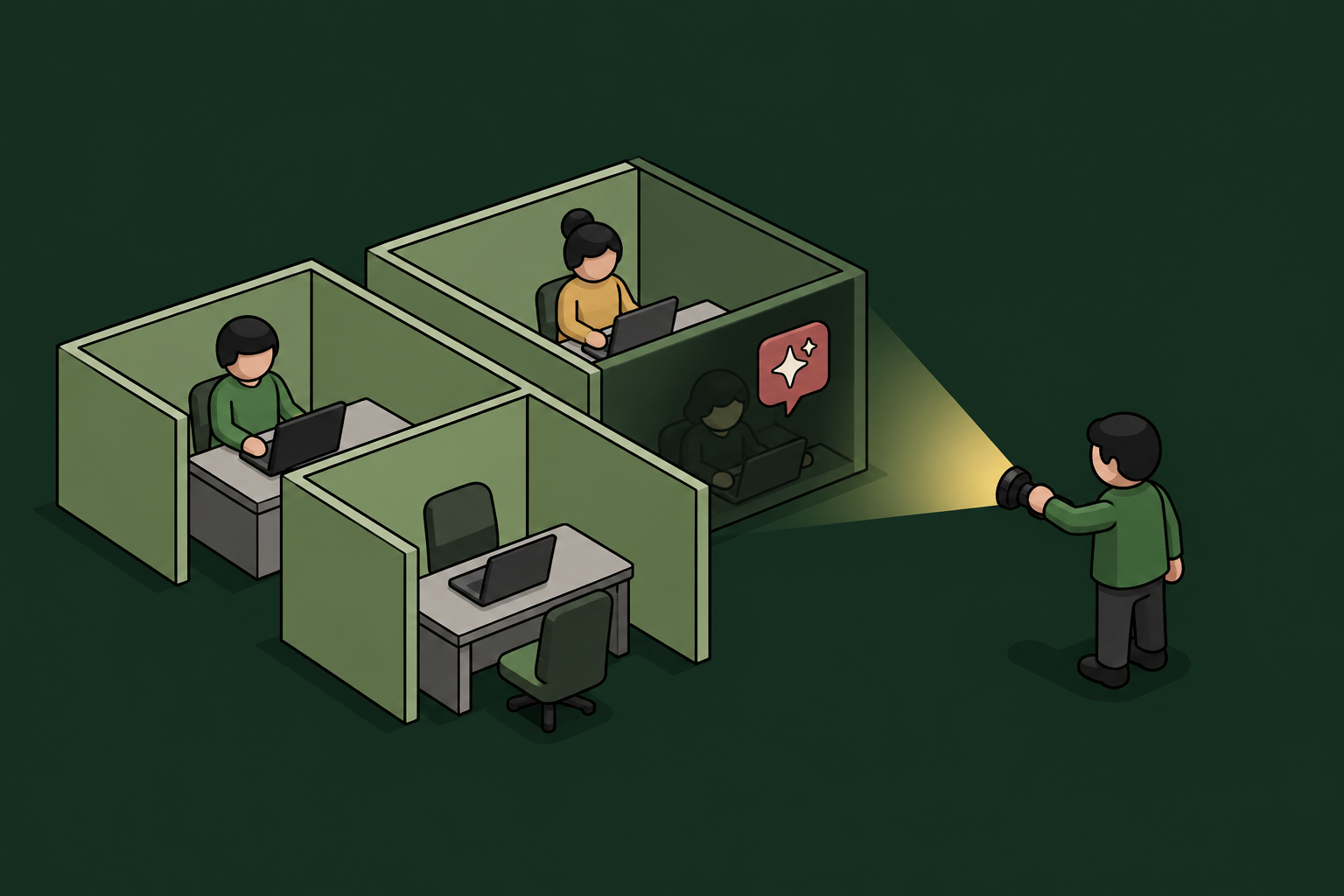
Every CEO I talk to asks some version of the same question: "How do I get my company moving fast on AI without losing control of it?"
It's the right question, but it's slightly behind the facts.
Your teams are already using AI. Chances are, they’re using it a lot.
They started months ago, mostly without telling anyone, and much of that work is genuinely good.
The decision in front of you isn't whether to allow it.
That ship sailed long ago.
The decision to make is whether to set up tooling so you can see, govern, and control AI agent use within your company.
The invisible AI usage sweeping your organization has a name. Shadow AI.
It means any AI tool, assistant, or agent an employee runs without security review or approval.
And it is far from a fringe problem.
In a 2025 Gartner survey of 302 cybersecurity leaders, 69% of organizations either suspected or had evidence that employees were using prohibited generative-AI tools.
Most organizations are trying to govern agentic and other AI use they can't fully observe in the first place.
So how to fix it and regain control?
Shadow AI is an infrastructure problem. Willow helps solve it.
TL;DR
- Shadow AI is already in nearly every company, so the question is visibility, not permission.
- Blocking pushes usage underground and slows the business, governing it lets you say yes safely.
- AI agents need a real identity and scoped permissions, like employees and apps already have.
Why is shadow AI already inside almost every company?
Because AI adoption ran ahead of policy (it almost always does) useful tools spread through an organization faster than any approval process.
AI is likely the most useful new tool most employees have ever touched.
When workloads can be compressed from hours to minutes, teams reach for it long before IT has a chance to formalize a position on it.
Let alone build the infrastructure required to govern it…
The scale is larger than most boards assume, too. Roughly 78% of AI users bring their own AI tools to work (per Microsoft's 2024 Work Trend Index).
The AI governance side has a long way to go before it catches up as well. IBM's 2025 Cost of a Data Breach report shows that only 37% of organizations have an AI governance policy in place.
It paints a pretty clear picture...
Most of the AI work in your company is happening in no man's land. No rules to govern it. No record to piece things together when it all goes wrong or to comply with regulatory reporting requirements.
And the pace is only accelerating.
While employees' first forays into AI were likely pasting text into an AI chatbot (ChatGPT, Gemini, Claude) to get answers to their questions, they’re now running autonomous workloads using AI agents (Codex, Hermes, OpenClaw, Claude Code, Cursor).
If you’re yet to come across AI agents in the wild and need to get up to speed with what defines one, an AI agent is a piece of software that uses a large language model to take real actions on your behalf, including:
- Read data
- Call tools
- Make changes
When that kind of software runs unsupervised, you have an actor inside your systems that nobody assigned, nobody scoped, and nobody is watching.
Often, it’s just as capable as a human (or more so).
That means it is also capable of ruining things, deleting them, or adding additional vulnerabilities you may never learn about.
These factors create an entirely different category of risk than someone pasting a question into a chatbot.
What does ungoverned AI actually cost when it goes wrong?
For the first time, IBM's 2025 Cost of a Data Breach Report broke shadow AI out as its own breach category.
- 1 in 5 organizations (20%) have already had a breach caused by shadow AI.
- Organizations with high levels of shadow AI face $670,000 more in breach costs than those with low or none.
- 97% of organizations that suffered an AI-related breach lacked proper AI access controls.
That third number is the one I'd put in front of a board.
Breaches aren't happening because AI agents are dangerous.
They're happening because the AI had no identity, no scoped permissions, and no record of what it touched.
Strip the AI agent part away and you are left with a standard governance problem.
And governance problems have known solutions.
For many teams, there is a serious deadline pushing AI governance and security measure adoption. The EU AI Act's obligations for general-purpose AI continue to phase in through 2026. If you sell into Europe, "we didn't know our teams were using it" is not a defence. Compliance is more than a policy document. It requires dedicated AI governance tools and engineering.
Why governing AI agents beats blocking or ignoring them
Govern, don't block, and don't pretend it isn't happening. Those are the three real options in front of every leadership team.
However, only one of them is actually working in practice.
(1) Block it.
Banning the tools and trying to enforce the ban feels safe but fails quietly.
When you block, what happens is usage moves to personal devices and accounts where you have zero visibility or record.
So, you haven't removed the risk. You've blindfolded yourself to it.
Shadow AI just became even darker.
(2) Ignore it.
Let it run and hope…
This is the default for most companies now.
They realize the huge benefits of AI, and don’t want to lose them.
But they’re also lacking a clear roadmap to govern it.
This may be the most expensive option of the three, because it's the path that produces the IBM breach numbers above.
No visibility and high shadow AI use means approximately $670,000 in additional costs per breach.
(3) Govern it.
Allow the tools, but route them through a layer that gives each agent an identity, scopes what it's allowed to do, and records every action.
By governing AI, you get both the AI speed boost and the control required to protect your organization from AI risks.
The companies winning with AI right now aren't the cautious ones, and they aren't the reckless ones. They're the ones who said yes on the condition that everything stays visible and governed.
How do you actually find the shadow AI you can't see?
You find shadow AI by looking in the places employees leave traces.
AI usage leaves fingerprints across systems you already run. That’s good news. Discovery is more achievable than most teams expect.
The practical detection methods, roughly in order of how fast they pay off, are OAuth and SSO grant logs, an endpoint agent and browser extension, network monitoring, code repo scans, and employee surveys.
(1) OAuth and SSO grant logs.
The identity provider (your Okta, Entra, or JumpCloud) pulls consent records.
It is often the fastest way to surface tools nobody told you about.
(2) Endpoint agent.
Pushed through your MDM, it surfaces every tool and skill in use, approved and unapproved.
That includes rogue MCP servers, personal API keys, and shadow AI deployments running locally on the machine. None of which would appear in browser history or network logs.
(3) Browser extension.
Inside the browser is where most employees first encounter AI tools. Think GhatGPT, Nano Banana, Claude, etc.
A governed Chrome extension enforces approved usage and catches unapproved tools before they reach production systems or become an audit finding.
(4) Network monitoring.
Inspecting outbound traffic for known AI-service domains flags connections to unsanctioned services from the network side.
(5) Code-repository scanning.
Engineers wire AI into products by embedding API keys in code. It creates significant exposure.
GitGuardian's 2026 report counted 1.27 million AI-related secret exposures in public GitHub (up 81% year on year).
(6) Non-punitive employee surveys.
Ask people what they use, with an explicit promise of no penalty. The 80% using public AI quietly will tell you.
This is never a one and done exercise, though. New tools appear every week. The strongest programs run several of these at once and keep running them.
The real fix: give AI agents an identity
The long term reliable solution to combating shadow AI is to give every AI agent a real identity, the same way you already do for every employee and every app.
This is the part most discussions miss. But we've collectively solved this type of problem before.
- On-prem software got Active Directory, one place that knew who every user was and what they could touch.
- SaaS got Okta and the other identity providers that carried that idea into the cloud.
- AI agents, until now, have had nothing. No identity layer, no access controls, no record.
Shadow AI simply lives in a missing layer that needs its own identification, detection and governance tooling.
An AI agent is a non-human actor in your systems, so it needs its own identity, distinct from the human who launched it but still tied back to that person.
Think of it as a new hire's badge and defined role. Except the new hire is software.
In cloud-native environments, these non-human identities can outnumber human ones by as much as 144 to 1.
Least privilege is the old security rule of giving any actor access to exactly what its task requires, and nothing more. The same goes for AI agents.
Not "this agent can reach our project tracker," but "this agent can read tickets in these two projects, and cannot delete anything."
Narrow permissions mean a compromised or confused agent can do far less harm.
This is the category my co-founders and I built Willow to own. The Agentic Access Platform. Okta is the access layer for people. Willow is the access layer for agents.
Each agent inherits a real employee's identity through your existing identity provider, gets permissions scoped to the action (what it can actually do inside each tool, not just which tools it can reach), and leaves a full audit trail tied to a real person (Willow Identity & Access).
When your CISO asks what a specific agent touched in the customer database last Tuesday, you pull that trail and answer in seconds, instead of reconstructing a session from fragments across a dozen logs.
Discovery of unmanaged tools runs through the endpoint agent and browser extension built into the platform (Willow Governance & Compliance).
Wix runs roughly 5,000 weekly active users and 600 governed tools through this model, with 1,000,000+ governed tool calls a week. Each is tied to a real identity. In the words of Head of AI Core at Wix, Asaf Yonay, "We are six to ten months ahead of most companies in AI adoption. More code to production, fewer incidents, real outcomes."
Like many organizations having success with agentic AI, Wix got there by saying yes to AI, not by locking things down. The governance layer is what made that possible at scale.
What should CEOs do this quarter?
See it, govern it, then enable more. You don't need a finished AI strategy to begin. You first need to stop flying blind.
Run a discovery pass first, because OAuth grants and an honest employee survey get you most of the picture in a week.
Then give the agents and tools already in use a real identity and scoped permissions instead of banning them.
Once you can see and govern, you can say yes faster and more often. Visibility is exactly what lets you accelerate safely.
The companies that win the next few years will be the ones that can see every agent in their org and govern it without slowing anyone down.
Further Reading
- Gartner: 69% of organizations suspect or have evidence of prohibited GenAI use (2025 survey of 302 security leaders): gartner.com/en/newsroom
- Microsoft & LinkedIn: 78% of AI users bring their own AI tools to work, 80% at small & midsize firms (2024 Work Trend Index): news.microsoft.com/source/2024/05/08/microsoft-and-linkedin-release-the-2024-work-trend-index-on-the-state-of-ai-at-work
- IBM: Cost of a Data Breach Report 2025 (1-in-5 shadow-AI breaches, $670K added cost, 97% lacked controls): ibm.com/reports/data-breach
- IBM: Only 37% of organizations have an AI governance policy in place (Cost of a Data Breach 2025): ibm.com/reports/data-breach
- GitGuardian: 1.27M AI-related secret exposures in public GitHub, +81% YoY (State of Secrets Sprawl 2026): gitguardian.com/state-of-secrets-sprawl-report-2026
- Cloud Security Alliance: Non-human identities outnumber humans up to 144:1 (Non-Human Identity Governance whitepaper): labs.cloudsecurityalliance.org/research
- Willow: Identity & Access and Governance & Compliance product pages (agent identity, scoped permissions, shadow-AI discovery): withwillow.ai/platform
Background Agents in the Enterprise
Most teams can spin up an agent. Few can deploy one their security team signs off on. Here's the framework that does both.
FAQS
No. Blocking feels safest and works the worst. Bans don't end usage. Employees relocate it to personal devices and accounts where you have no visibility or audit trail. You get the same risk, less ability to see it, and slower teams. Governing AI use protects the company without the blind spots a ban creates.
It means treating the agent as a known actor with its own credentials and a defined, limited set of permissions, tied back to the real employee who runs it. In practice the agent inherits that person's identity through your identity provider, so its access reflects their role and updates when they change jobs or leave. That makes every action traceable to a human and keeps a stray agent from reaching data it was never meant to touch.
Most AI security tools watch for bad behavior after an agent acts and try to catch problems with guardrails. An identity-and-governance layer works earlier. It decides what each agent may do before it acts, scopes those permissions to the task, and logs everything.
Everything you need to get your Basecamp running.



Your agents are already in the wild.
Give them a Basecamp. Go from AI chaos to AI work, in minutes.
